|
|
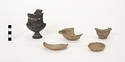
| Unguentarium. Well. Unguentarium Fragment. Black Glaze Beaker Fragment. Drain. Lid Fragment: Cooking Ware ... ΛΛ-10 1890, 1891 P 32011 P 32491 P 32492 ΛΛ 1514 P 32811 P 33954 Lot ΛΛ 352 Lot ΛΛ 26 G 5:3 E 5:4 P 32491 P 32492 P 32811 P 33954 ... June 1937 |
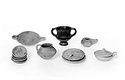
| The remains of a pyre disturbed by the construction of Wall 106. The compact, light brown soil contained some ash and bone and 5 nearly complete pots or saucers ... First half 3rd. c. B.C. |
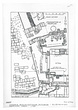
| Eleusinion; plan of Propylon Area ... Richard C. Anderson William B. Dinsmoor, Jr ... Based on plan by W. B. Dinsmoor Jr. 1980. Drafting Film Drafting Ink ... December 1996 |
Eleusinion; plan of Propylon Area ... Richard C. Anderson William B. Dinsmoor, Jr ... Based on plan by W. B. Dinsmoor Jr. 1980. Xerox Drafting Ink
Pen ... December 1996 |
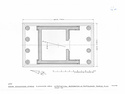
| Eleusinion; plan of restored temple ... Richard C. Anderson ... Drafting Film Drafting Ink ... December 1996 |
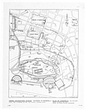
| Plan of Acropolis and adjacent areas to the north and east, with ancient and modern features superimposed ... Richard C. Anderson ... Scanned. DB: 131. Dirty Drafting Film Drafting Ink ... December 1996 |
| Located in Middle Stoa, west, south aisle, beneath pressure pipe (cf. A 4900). The siting of the well is remarkable in its proximity to Well I 13:3, also Geometric in date, which was found in 1968 only ... Second half of 8th c B.C. |
| Excavation of this pit began in 1995, tentatively identified as a pyre. This proved to be so with continued excavation in 1996. The deposits J 2:8 and J 2:9 were combined to become J 2:9. Miniature vessels ... Ca. 300 B.C. |
|
|
.jpg.icon.jpg)