|
|
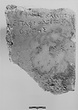
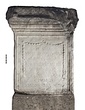
| Inscribed block.
Broken away above, below, and in back.
The right side has a drafting and a rough picked surface (not anathyrosis); it is bevelled. The final "Σ" of the first line is inscribed on this ... First half of 3rd. century A.D. |
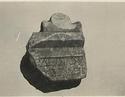
| Globular, with small flattened top, and larger flattened bottom.
Decorated with a band of double concentric circles incised around a central dot; above and below this band, three incised grooves.
Brown ... 13 May 1933 |
| Three fragments from an inscribed architrave; grave monument.
Fragment Η 158 a), the largest fragment, broken at both ends, preserves the rough picked top and back, and the smooth finished under surface ... (Η 158 a) 18 March 1933
(Η 158b) 18 March 1933
(Η 158 c) 20 May 1933 |
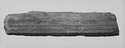
| Part of large inscribed block.
Two fragments; the smaller, which joins, comes from the uniscribed back.
Back rough picked; top picked fine, with a smooth dressed band along front and right side; right ... Ca. 200 A.D. |
| Inscribed block from top of monument.
Broken at back and sides; the bottom surface, dressed fairly smooth, is cut at less than right angles to the inscribed face.
Below an antefixial ornament, a splay ... 4 May 1933 |
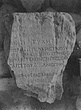
| Large inscribed base of grave monument.
Dimensions preserved complete, though at the bottom the projecting base-moulding has been broken away, and the under surface is preserved only near the middle of ... 113-136 A.D. |
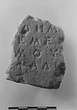
| Fragment of inscribed stele.
Broken away on all sides.
Parts of four lines of the inscription preserved.
Pentelic marble. Found in Byzantine context, over the Temple of Ares. Leica, III-42 ... Early 2nd. century B.C. |
| Fragment from inscribed stele.
Broken all round.
Parts of three lines of the inscription preserved, with a vacant space to the right.
Hymettian marble. Found in a context of late Roman and Byzantine times, ... Mid. 3rd. century B.C. |
|
|