|
|
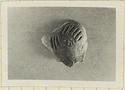
| Only the left side of the head of the cock preserved.
Couged technique. Heavy fabric, burnt gray.
Late Roman. Grey ash fill over curved foundation trench.
Late Roman. Leica ... 27 February 1934 |
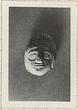
| Broken away behind and below.
Gouged technique. Traces of white paint. Red clay.
Late Roman. In late fill. Leica ... 28 February 1934 |
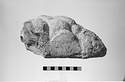
| Inscribed fragment.
Mended from two pieces found separately, but from the same fill.
Temple Inventory.
Seven lines of the inscription preserved, with a trace of an eighth above; stoichedon.
Clear traces ... 5th. century B.C. |
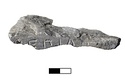
| Inscribed fragment.
The under surface rough picked; the sides and top rounded and worked into a series of low lump-like projections, picked moderately fine.
The top damaged, and the left side broken away ... 27 February 1934 |
| Inscribed fragment.
Broken on all sides.
One line of the inscription preserved, with five letters.
Traces of red in the letters.
Hymettian marble. Found in late Roman context, over the Tholos floor. Leica ... Last half of 1st. century B.C. |
| A large piece out of the top of the handle.
The clay, fine micaceous, pinkish.
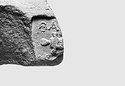
Rectangular stamp, set on the curve; emblem a herm; to the right the letters "Θ Α". Dim: W 0.038 ca*
Par: SS 06455, SS ... 26 February 1934 |
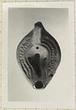
| Broken but complete.
Plain discus. Herringbone rim. Handle solid; grooved above.
Two grooves on the bottom.
Light red clay, unglazed.
Type XXVIII of Corinth collection.
Cf. Corinth IV, ii, pp. 102-114, ... Late 4th-early 5th c. A.D. |
| Necked around nozzle but otherswise complete.
Five filling holes on plain pear-shaped discus. Debased herringbone on rim.
Handle solid, grooved above. Beneath, faint grooves.
Pinkish to buff clay, unglazed ... Late 4th-early 5th c. A.D. |
|
|