|
|
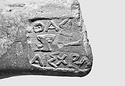
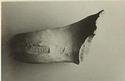
| Much battered fragment of typical handle.
Soft clay, russet to grey.
Fresh impression with smear in top line; broken and chipped awy to right; double axe(?). Finished Byzantine level. Θασίω̣[ν]
double ... 26 April 1933 |
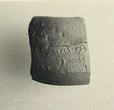
| Much worn fragment of Knidian type.
Right(?) end of losange-shaped impression preserved, much worn. Par: SS 00277* With early Byzantine and late Roman sherds. Ἀπολλων | ίου (ΙΟΥ retr)
bee
Κνιδι( ... 26 April 1933 |
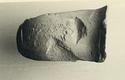
| Curve fragment.
Coarse greyish-red, yellow at surface.
Impression probably from same die as SS 313; worn above left, below, centre; left edge broken away; retrograde. Par: prob from same die as SS 00313* ... Late Roman |
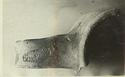
| Stocky handle lump beneath.
Coarse light reddish-buff clay; little or no slip.
Impression incomplete above and below, worn across the middle and damaged by chips.
Cf. Dumont (1872), pp. 192, 299-300 ... 26 April 1933 |
| Small handle, broader inside than out; rough fabric.
Granular clay, dark gray with reddish core and red surface layer under light slip.
Stamped on lower(?) attachment; deep set fairly fresh impression, ... 24 April 1933 |
| Much battered.
Greyish-red clay; slight trace of slip.
Much worn impression. Trench Ν, outside House. Πολι bouk- ούχου
Ἀστ̣ρ̣ ranion αγάλου
(Ρ retr) Leica ... 24 April 1933 |
| Knidian shape; over a quarter of a rolled rim with overhung; a groove below it.
Coarse red clay; light slip; smutted; red stain.
Worn impression from a die with flaw at each end; lunate "sigma". Dip: ... Ca. 200 B.C. and earlier |
| Rather irregularly made thick handle.
Fine red clay with distinct grey core; light slip; red stain.
Impression from same die as SS 1189; shallow and worn at left end. Dip: red stain*Par: same die as ... 27 April 1933 |
|
|