|
|
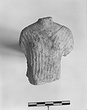
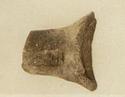
| Preserved from hip to lower part of neck; with shoulders and upper part of arms close to body.
A girl dressed in a clinging Ionic chiton. Archaistic.
Pentelic marble. Cistern, south chamber. Leica, LXXV-95, ... 5th or 4th B.C. |
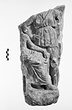
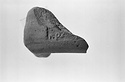
| Broken above and at both sides; back very rough-picked.
A standing female figure in girt peplos, head and left arm missing, is seen behind a semi-draped, probably male figure, seated right, with back and ... 21 April 1932 |
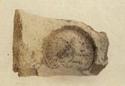
| Shape similar to Knidian; broken at curve close to neck.
Clay similar to Knidian.
Large impression, set close to neck; incomplete to the right, below the boukranion; indistinct. From bedrock. [ Ἐπὶ ... 21 April 1932 |
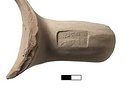
| Thick, broken at curve.
Dark red clay, with small gray core; traces of light slip.
Shallow impression, narrow, badly worn. Class: Ch?* From bedrock. Ἱκεσίου Leica ... 21 April 1932 |
| Rather broad; small fragment not preserving junction with neck.
Coarse, pinkish-buff clay; grey core.
Impression set obliquely; incomplete upper right and lower left. South chamber of Cistern, lowest ... 22 April 1932 |
| Large, high rising, broken at curve; part of rim preserved.
Not very fine clay; otherwise typical.
Doubled impression; boustrophedon; top line inverted. Stp: doubled* Well. Ἐπὶ Ἀγλω
κρίτου Leica ... 1st century B.C. |
| Typical shape; broken before curve.
Typical clay; darkened slip.
Left end of the impression broken away; shallow; chip out of middle. Stp: prob incomplete abv* Below top level of retaining wall. [Μενεστρά] ... 22 April 1932 |
| Apparently typical Knidian; junction with neck not preserved.
Coarse red clay, greyish at core.
Mostly of the impression broken away, with large piece of handle; lower left corner preserved.
Group "D" ... Third quarter of 2nd century B.C. |
|
|