|
|
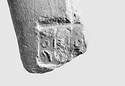
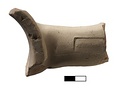
| Split fragment of slightly arched handle.
Micaceous russet clay.
Impression smeared above and chipped, especially below; retrograde.
Cf. Pridik (1917), p. 53, no. 398.
Early Thasian. Par: cf Pridik 1917, ... Ca. 420-390 B.C. |
| Broadish slightly arched handle; part of rim preserved.
The spelling is clear; does not occur in Nilsson (1909). Msc: this stp does not occur in the Lindos collect* Finished Middle Stoa Building Field, ... 20 May 1933 |
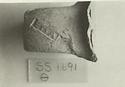
| Broad handle with short upper part.
Fairly fine micaceous clay, light reddish-buff.
Impression from same die as SS 304; chipped to right, but no letters missing. Par: same die as SS 00304* Terrace test ... 20 May 1933 |
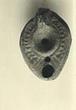
| Mended from many pieces; a fragment or two missing from the body.
Small wick hole sunken filling hole surrounded by grooves. Heavy ring base.
Heavy fabric. Clay and slip now gray, on unglazed exterior; ... 20 May 1933 |
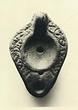
| Complete.
On rim, debased vine pattern.
Plain discus.
Handle solid, double grooved above and below.
On the reverse, a single circular groove enclosing a palm branch with four small circles; another circle ... 19 May 1933 |
| The top of the handle broken off; otherwise complete.
On rim, herringbone.
Plain discus.
Handle apparently solid, triple grooved above; below the handle is only simulated, by means of four rather broad ... 20 May 1933 |
| A small piece missing from the rim; otherwise complete.
On rim, herringbone pattern, set off from the discus by two ridges.
Plain discus, with two ridges round the central filling hole.
Handle solid, double ... 20 May 1933 |
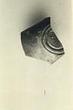
| Fragment of reverse.
Double circular groove, enclosing the letter "C".
Red clay and wash.
Type XXVIII of Corinth collection. Southeast corner of "Royal Stoa", lowest layer above "classical floor". Leica ... 20 May 1933 |
|
|