|
|
Apparently complete.
It is very thin and forms a shallow S-curve. One side is smooth, the other has two lengthwise ridges.
Obsidian. Well 9; container 10; Neolithic. Leica, 83-505 ... 13 March 1939 |
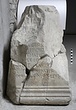
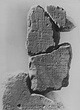
Fragments from an inscribed block.
Fragment Λ 36 a), the top smooth; other edges broken.
Part of five lines of the inscription preserved.
Fragment ΓΓ 49 b), part of two inscribed faces and the top preserved ... 5th. century B.C. |
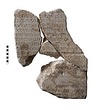
| Inscribed fragments.
Fragment ΕΕ 31 a), part of rough picked top, and probably also part of rough picked bottom preserved. Only a very small portion of the inscribed face is preserved.
Five lines of the ... a) (ΕΕ 31) 24 February 1939
b) (ΕΕ 49) 13 and 14 March 1939 |
| Inscribed fragments.
"POLETAI" records: Alkibiades.
Fragment ΑΑ 82, part of smoothly-dressed right side preserved.
Eight lines of the inscription preserved.
Joining fragment ΒΒ 143, inscribed face and ... 5th. century B.C. |
| Inscribed fragments.
Imperial letter.
Fragment Ν' 72 a), inscribed face and rough picked back preserved; broken elsewhere. Traces of third line exist; this line was either deliberately erased or destroyed ... 181 A.D. |
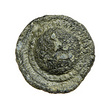
| A: shield with dotted rim. A monogram (a large alpha) in low relief on shield.
B: plain.
CF. IL 832, same type with coins nos. 1-3. Entered as coin no. 3, for the day. House A: destruction fill. Leica ... 14 March 1939 |
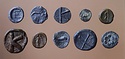
| Obverse: a large K.
Reverse: plain. Turkish fill, sand in gully. Leica ... 14 March 1939 |
| Inscribed fragments.
"POLETAI" record.
Confiscated property of those who profaned the Mysteries.
Fragment ΙΙ 2 a), inscribed face only preserved.
Thirteen lines of the inscription preserved.
Belongs to ... 414 B.C. |
|
|