|
|
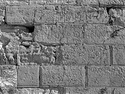
| The inscribed blocks are a little west of the center of the wall, and as high above the limestone outcrop on which the wall is bedded as the stone-cutter could conviently reach. The total length of the ... 12 July 1937 |
| Inscribed epistyle block.
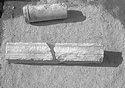
Two large, presumably joining pieces of an ionic epistyle block. Several large pieces missing but generally well preserved, particularly the front.
Profile from bottom up: three ... 11 June and 5 July 1971 |
| Inscribed statue base.
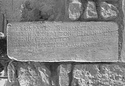
Large rectangular base for a statue of the Emperor Trajan. Left rough picked on top, perhaps to receive another block. No trace of a cutting, though part of the top is still concealed ... 28 July 1971 |
| Rough-picked back, right side, bottom except for broken tenon and part of top, with cutting above third figure from right, preserved.
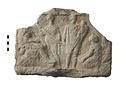
Four figures, from left to right: seated draped figure right, with ... 2 May 1952 |
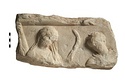
| Part of top preserved; otherwise broken.
The heads and shoulders of two figures are preserved, and between them is a narrow object, a torch (?). The left-hand figure wears a veil over her head and appears ... January 1939 |
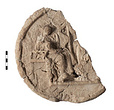
| About half preserved. A few chips missing, including the woman's right shoulder. The back roughly tooled.
Round flat disk with raised band around edge of front.
In relief, a draped female figure, Demeter, ... 15 May 1940 |
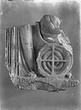
| Two joining fragments. Bottom and, in part, back preserved.
At left, the left leg and drapery of a standing female figure, next to a wheeled car with the upper body of a partly draped youth, right. At ... 12 March 1938 |
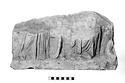
| Left end, rough-picked back and bottom preserved. Only the lower legs of the figures are preserved.
At extreme left, a draped standing figure, facing; next to her a shield, its inner side exposed; this ... 1937 |
|
|