|
|
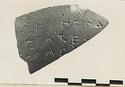
| Fragment from the foot of a large vase (column krater?) moulded in two degrees.
Inscribed on the top.
Black glaze, much chipped, on upper surface.
Joins the ostraka P 17915 + P 19209, i.e. from the ... 8 April 1953 ... Fragment from the foot of a large vase (column krater?) ... Inscribed on the top.
Black glaze, much chipped, on upper surface.
Joins the ostraka P 17915 + P 19209, i.e. from the same pot. |
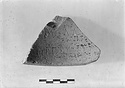
| Broken all around. Parts of three lines inscribed on coarse sherd.
Tan-orange clay. The name on the ostraka is Phrynondas not Phrymondas as is written on the card. (PK) Layer 1 of trench in central area ... 25 May 1973 ... The name on the ostraka is Phrynondas not Phrymondas as is written on the card. |
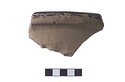
Rolled rim, spreading ring foot, single bell handle.
Another, P 23340 H 12:15-U, with a similar tightly rolled rim and space for one handle only (now missing), has a disc foot with rounded profile, similar ... The context, a filling over bedrock below the west part of the Middle Stoa, is inconclusive, being mostly of the second half of the 5th century ... Another, P 23340 H 12:15-U, with a similar tightly rolled rim and space for one handle only (now missing), has a disc foot with rounded profile, similar to the ostraka 1776, 1780, Fig. 21. On 1790 both the foot and the handle, close in shape to that of the one-handler 728, Pl. 30, suggest a date of ca. 500 B.C. |
Base and part of wall.
From a small lekane. High flaring ring foot. Inscribed on the underside. For the Graffiti see above under 1792.
The neat flaring foot resembles that of 1784, or the ostraka, 1770, ... Context ca. 470-460 B.C ... Inscribed on the underside. For the Graffiti see above under 1792.
The neat flaring foot resembles that of 1784, or the ostraka, 1770, 1771; the fragment comes apparently from a pot earlier in type than most of the lekanai from this deposit. The reading of the name Euphronios, restored in the original notice of the graffito and sometimes quoted, cannot be verified. |
| From the rim of a large krater. Rather small rolled rim. Black glaze on the inside, on the rim, and probably for a band below the inscription on the outside.
Scratched in the dry clay: Mixed fill over ... 14 May 1934 |
Rolled rim, spreading ring foot.
Typical of many examples of the late 6th and early 5th centuries. Others similar, but with disc foot, are not necessarily later; cf. 1787, also the fragments used as ostraka, ... Context ca. 520-490 B.C ... Typical of many examples of the late 6th and early 5th centuries. Others similar, but with disc foot, are not necessarily later; cf. 1787, also the fragments used as ostraka, 1773-1779, Fig. 21. |
| Fragment from the rim of a krater, glazed on the top of the rim, and the inside with red to black glaze nearly all peeled off. The outside so far as preserved, seems to have no glaze decoration but was ... August-September 1932 |
Heavy rolled rim flattened on top and meeting the inner face of the wall at a right angle. Ostrakon of Themistokles Neokleous (482 B.C.) ... 482 B.C. |
|
|