|
|
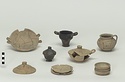
| Grave over drain A1 (House A). Date based on the fact that the lopas has the upturned handle and the flat rather than domed lid, not found in examples from the later pyres. LT
West of House C. Pottery ... First half of 4th. c. B.c ... Grave over drain A1 (House A). Date based on the fact that the lopas has the upturned handle and the flat rather than domed lid, not found in examples from the later pyres. ... Construction of a Roman house had removed all trace of earlier structures here. ... Originally A 20:2.
Published together with A 18:3 in Hesperia 47. |
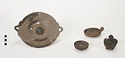
| Sacrificial pyre, disturbed; a small pyxis (P 14864) is close to that from B 18:4. First half of 4th. c. B.C., perhaps first quarter.
West of House C. Pottery and cinders in pit in stratum. The pyre was ... First half 4th. c. B.C ... Sacrificial pyre, disturbed; a small pyxis (P 14864) is close to that from B 18:4. ... West of House C. Pottery and cinders in pit in stratum. ... Construction of a Roman house had removed all trace of earlier structures here. |
Pocket of soft fill in bedrock at corner of Late Roman house, with a hoard of lead tokens. No pottery catalogued.
Herulian debris: cf. D 10:1, D 11:7 Coins:
25 May 1935 #8 Estimated Grid
No pottery catalogued ... 25 May 1935 ... Pocket of soft fill in bedrock at corner of Late Roman house, with a hoard of lead tokens. |
| Well in West Colonnade of Roman House H. Covered by a large handsome marble well-head, apparently reused. Cut through bedrock. Diameter ca. 1.20m, water at -3.60m.
Two distinct POU fills. One at ca. -4.50m ... June-August 1970 ... Well in West Colonnade of Roman House H. Covered by a large handsome marble well-head, apparently reused. ... A.D.. probably to be associated with the reoccupation of Roman House H by squallers, the other at -6.30m to -6.75m of the 6th c. A.D., reflecting period of use of the house. |
| Well in East Colonnade of Roman House H. Diameter 0.80m, lined with field stones set in mortar. used as a cistern as well.
No useful pottery dates. Capital from colonnade A 3866 and part of shaft found ... 29 July 1970 ... Well in East Colonnade of Roman House H. Diameter 0.80m, lined with field stones set in mortar. used as a cistern as well.
... Capital from colonnade A 3866 and part of shaft found at 2.50m-3.00m, indicating destruction of house (late 6th, 580's by Slavs). ... See also Q 21:4 from same house. Marble heads (S 2354-2356) deliberately discarded before house went out of use. |
| Pyre in Room 8 of Roman House H. Concentration of artifacts, bone, and flecks of carbon in stratum, no pit discerned. the pyre lay within a red fill apparently contemporary with it, but with some later ... 300-290 B.C ... Pyre in Room 8 of Roman House H. Concentration of artifacts, bone, and flecks of carbon in stratum, no pit discerned. the pyre lay within a red fill apparently contemporary with it, but with some later intrusions; no trace of a floor above it survives. The stratigraphy around the pyre could not be related to the architectural history of the house, though the date allows association with the reconstruction of the house near 300. |
| North of House G (RSY=Pyre 13).
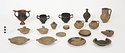
Concentration of artifacts, small pieces of bone, and burnt material in stratum, no pit discerned. The pyre is cut by the trench of a wall of a Roman house to north. It ... 290-250 B.C ... North of House G (RSY=Pyre 13).
... The pyre is cut by the trench of a wall of a Roman house to north. It was found in digging "Hellenistic" fill; no further information about the stratigraphy or about the pottery from that fill is available. although the pyre was apparently not burnt in situ, the objects lay in a compact mass, not much disturbed, and they are mostly complete. |
House K: Brown fill (publ. House U). Filling between terrace wall and house wall at the extreme west end of the Areopagus; a brown gravelly filling of early Roman date found here undisturbed but occurring ... Early Roman ... House K: Brown fill (publ. House U). Filling between terrace wall and house wall at the extreme west end of the Areopagus; a brown gravelly filling of early Roman date found here undisturbed but occurring also throughout this general vicinity, sometimes with later intrusions ... L 3709 (ΝΝ 460) recorded on deposit sheet and although from Terrace brown fill it is from a different grid. |
|
|