|
|
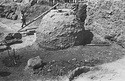
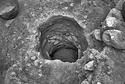
Anne McCabe ... Pithos D, adjacent to Pithos A at the NE, is built of stone and broken tile, beehive-shaped, unlined, with no floor. The wall of Pithos D appears to have been cut by the construction of the mortar wall ... 4-6 July 2007
31 July 2007 ... Pithos D, adjacent to Pithos A at the NE, is built of stone and broken tile, beehive-shaped, unlined, with no floor. The wall of Pithos D appears to have been cut by the construction of the mortar wall of Pithos A, and both vessels were damaged by the modern basement. ... At 53.764m. was found a segment of a bronze toothed blade (BH 228). |
| "From the phot. and description, p. 555, this appears to be a built pithos, rather than a cistern." [deposit nb] Grid 30/ΙΔ also mentioned ... 28 July-3 August 1931 ... "From the phot. and description, p. 555, this appears to be a built pithos, rather than a cistern." |
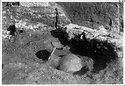
| Grave 2 in notebook. Child of about two (or 10?) months, body placed in plain pithos, which rested on its side at the bottom of a pit; the mouth closed with a stone slab.
The burial forms a group with ... 750-725 B.C ... months, body placed in plain pithos, which rested on its side at the bottom of a pit; the mouth closed with a stone slab.
The burial forms a group with two other graves (D 16:2, D 16:4) set in angle formed by intersecting roads. |
| Rodney S. Young ... Grave 13 in notebook.
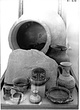
Two skeletons of small children lay in a pithos which had been put on its side; its mouth was stopped by a stone slab.
Most offerings were inside the pithos, but two kantharoi and ... Late Geometric ... Two skeletons of small children lay in a pithos which had been put on its side; its mouth was stopped by a stone slab.
... An animal bone was found under a coarse pitcher left outside the pithos at its mouth; carbonized matter, perhaps from a food offering, was found in one of the kantharoi.
No evidence of re-opening, hence this was probably a double funeral. |
Original bottom of pithos was damaged (probably by ground water) and a second, higher bottom consisting of squarish terracotta tiles laid. Fill above second, higher floor was unusually rich in pottery ... Byzantine ... Original bottom of pithos was damaged (probably by ground water) and a second, higher bottom consisting of squarish terracotta tiles laid. Fill above second, higher floor was unusually rich in pottery and was thus given a deposit number. |
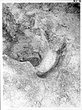
| Grave 3 in notebook. Outside Archaic cemetery, inhumation burial. Deposit list says black glaze pithos (P 8922) containing the bones of a child and four small vases. The pithos lay on its side with the ... Last quarter of 6th century B.C ... Deposit list says black glaze pithos (P 8922) containing the bones of a child and four small vases. The pithos lay on its side with the open mouth to northeast. The bottom had been cut by a late fifth century well and the upper side was caved in. |
| "Room D" is the triangular area at L/15,16-2/10,12, NW of Wall 1, in E corner of basement of No.3. Hastings Street, bounded by the NE and SE walls of basement).
Bell-shaped vessel built of horizontally-laid ... 10th-11th c. A.D. |
Well 2: archaic. Diameter, top ca. 1.00; bottom ca. 0.90m.
Water level:ca -7.00m In the use filling, along with the plain water pots was a black-figured neck amphora assigned to the Edinburgh painter ... Last quarter of the 6th c. B.C ... In the use filling, along with the plain water pots was a black-figured neck amphora assigned to the Edinburgh painter.
Dumped filling consisting largely of mudbrick, broken rooftiles and other debris, along with a pithos-top well head.
An upper filling was not a dump, but a washed-in filling, containing a scattering of figured fragments. |
|
|