|
|
Rectangular; no handles.
Similar, with one handle, P 8305 C 12:2 Hesperia, XXVII, 1958, pl. 49 d and p. 232; also, from Olympia, Olympia-Bericht, IV, pp. 103-104, figs. 87-88 ... Context not later than 4th c. B.C ... Similar, with one handle, P 8305 C 12:2 Hesperia, XXVII, 1958, pl. 49 d and p. 232; also, from Olympia, Olympia-Bericht, IV, pp. 103-104, figs. 87-88. |
Duck askos, small series. Shallow saucer mouth on tall neck; raised base flat beneath; bag-shaped body. Pinkish buff clay, smooth surfacing; dull black glaze on the mouth inside.
Similar proportions but ... Context ca. 350-300 B.C ... Similar proportions but plain flaring mouth, from Olympia in the local black glaze: Olympia-Bericht, VI, 1958, p. 45, fig. 24; early 4th century. |
Part of bowl and lip.
Convex lip, short upper wall, low wide bowl. Scraped groove just above foot. Decoration inside: palmettes within two incised lines.
The shape, lacking the foot, is uncertain, but ... 390-380 B.C ... The shape, lacking the foot, is uncertain, but the fragment, found in Corinth, comes most likely from a stemmed cup made in Olympia, the local shape best called the Olympia- cup from the examples found there and published by Eil- mann and Schiering (cf. p. 11, note 14). ... Eilmann set the beginning of the Olympia series at about 450 B.C.; it flourished with minor variations throughout the century, with a few stragglers. One of these, Olympia-Bericht, III, 1941 (for 1938-39) p. 46, fig. 36, gives a close parallel for 650. |
Wide-mouthed pot, the rounded bottom forming a sharp angle with the shoulder; strap handle rising from rim. Bottom pierced with many small holes. Cooking ware.
Fragments from the bottoms of others similar ... Context ca. 375-340 B.C ... Fragments from the bottoms of others similar are not uncommon; see e.g. from Olympia: Olympia, IV, p. 197, 1272; from Olynthos: Olynthus, XIII, pl. 174, 461 A and B; pl. 253, 1053. |
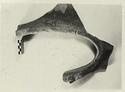
| Shallow bowl. Legs riveted at the rim and a pierced disk-shaped handle on one side.
Thin and poorly made.
Cf. ArchEph (1917), pp. 208-209 (for tripods found at Sounion); Olympia IV, pl. XXVII, nos. 536 ... 5 April 1933 ... ArchEph (1917), pp. 208-209 (for tripods found at Sounion); Olympia IV, pl. XXVII, nos. 536 ff (for those found at Olympia). |
| Broken all around and behind.
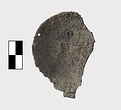
The fragment comes from the middle proper left side of a figure wearing an inner garment and a clock (chiton and himation). The surface of the garments is rasped. The left ... 1948 ... Same type as statues of Regilla Poppaea and two female statues by Eros and Eleusinios, cf. Olympia III, pls. 68.5, 63.4-6. |
| A trough tile with a large hole (only partly preserved) surrounded by a rim to prevent water from running in. The rim is pointed at one end.
Buff clay with red particles. Dull red glaze, much flaked, on ... April 1934 ... A 429 (Β 967), also A 690 (ΠΘ 2333).
Cf. Olympia, Text, II, p.17 and fig. 10, a and b. |
Apparently complete in a single letter: A; np letters to either side. Upside down to vessel.
Single alphas are often found on objects dedicated to Athena, undoubtedly as abbreviations of the goddess' ... Elsewhere single alphas may have some other meaning: e.g. the fourteen complete 5th c. examples from Olympia, W. Schiering, Olympische Forschhungen V, 1964, p. 156, no. 79, and the eleven from the Pnyx, G. |
|
|