|
|
| David Scahill ... Protogeometric/Early Geometric well under floors in Room 1, Classical Building II, on north side of south ashlar wall. See J 3:9 for the burial within this well.
Cf. Hesperia Suppl. 50 (2018), p. 106, ... 27 June 2001
17 July 2002 ... Protogeometric/Early Geometric well under floors in Room 1, Classical Building II, on north side of south ashlar wall. |
Fillings behind retaining wall and in road.
SW Building, rooms 3, north, south. Coins:
13 March 1934 #1, #2
14 March 1934 #37
15 March 1934 #37-#38
24 March 1934 #31 ... 6th c. B.C. and earlier ... Fillings behind retaining wall and in road.
SW Building, rooms 3, north, south. |
| Marcie Handler ... The Pyre was revealed in a layer of 4th c. fill in the north end of Room 6, just south of Wall 8. Room 6 is defined by the street wall (Wall A) on the west, Wall 7 on the east, Wall 9 on the south (preserved ... 4th c. B.C ... The Pyre was revealed in a layer of 4th c. fill in the north end of Room 6, just south of Wall 8. Room 6 is defined by the street wall (Wall A) on the west, Wall 7 on the east, Wall 9 on the south (preserved only as a stub on the east side of the area), and possibly Wall 8 or Wall 6 on the north.
2.5 meters SW of the pyre, a patch of floor surface at J/10-1/20 at 52.188 masl. was found. ... This pyre is the northernmost pyre found in Section ΒΖ North, and its location suggests that the Classical Commercial Building continues this far north. |
Mycenaean Tomb under Valerian wall (Burial 12).
It was impossible to fix the limits of the tomb in any direction, since at the north and south it was cut by the wall, an operations could not be extended ... Myc. III B ... Mycenaean Tomb under Valerian wall (Burial 12).
It was impossible to fix the limits of the tomb in any direction, since at the north and south it was cut by the wall, an operations could not be extended to the east and west, owing to the rapid flow of water from the surface of bedrock. |
Fillings associated with Southwest and North Buildings (78-99/ΙΣΤ-ΚΘ) and early walls to west of Great Drain.
pottery p. 1189, vol VII ... Subdivisions:
.1=Filling over bedrock.
.2=Fillings behind retaining ... Various levels and dates |
Child's burial in south wall of Marble Worker's House.
Bones examined 20 June 1975 and found to be an immature animal, not human (canid-puppy?).
Identified as pyre by SIR. Set into a shallow roughly ovoid ... Late 4th c ... Child's burial in south wall of Marble Worker's House.
... Set into a shallow roughly ovoid pit measuring ca. 0.27m east-west by 0.33m north-south. |
Well at 71/ΛΒ (diameter ca. 1.10m) near the east wall of the entrance porch.
Narrows toward bottom, collapsed at top. Six footholds preserved at south, three at north, spaced at ca. 0.50m. Uniform fill ... Late 8th in early 4th c. B.C ... Well at 71/ΛΒ (diameter ca. 1.10m) near the east wall of the entrance porch.
... Six footholds preserved at south, three at north, spaced at ca. 0.50m. |
| David Scahill ... At northeast corner of Classical Building II; on south side of dromos of Tomb K 2:5, and separated from it by ca. 0.6m of bedrock. Chamber cut through bedrock. The northeast corner of chamber defined ... LHIII A:1 ... At northeast corner of Classical Building II; on south side of dromos of Tomb K 2:5, and separated from it by ca. 0.6m of bedrock. ... Rest of tomb runs under later wall foundations to the south and west.
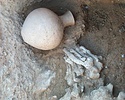
... Partially articulated skeleton laid out against the north wall of the tomb, with feet to the east. |
|
|