|
|
| North of House G (RSY=Pyre 13).
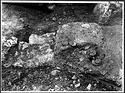
Concentration of artifacts, small pieces of bone, and burnt material in stratum, no pit discerned. The pyre is cut by the trench of a wall of a Roman house to north. It ... 290-250 B.C ... North of House G (RSY=Pyre 13).
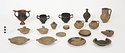
... The pyre is cut by the trench of a wall of a Roman house to north. It was found in digging "Hellenistic" fill; no further information about the stratigraphy or about the pottery from that fill is available. although the pyre was apparently not burnt in situ, the objects lay in a compact mass, not much disturbed, and they are mostly complete. |
Silt fill of early road drain to North of SW Fountain House. Coins:
10 August 1961 #5 ... 325-275 B.C ... Drain North of Southwest Fountain House |
Lower levels of cistern to N. of House of Greek Mosaic.
Connected by tunnel to another chamber that was apparently cleared by Wilhelm Dorpefeld in the 19th c. Roman fill in mouth. Coins:
6 July 1964 # ... Ca. 325-290 B.C ... Cistern North of House of Greek Mosaic in ΔΕ |
Fillings associated with early houses on the lower north slopes of the Areopagus; various levels and dates.
Both houses were built in the 6th century B.C. and destroyed by the Persians; both also have ... 6rd c. B.C.-3rd c. A.D ... Fillings associated with early houses on the lower north slopes of the Areopagus; various levels and dates.
... Southwest House, Rooms I-VIII, 42-55/ΚΖ-ΜΖ:
The earliest house had a court on the west with a Well (B) and two small rooms at the north. ... The latest period of the house is the Herulian destruction.
|
| Pyre in north central room of house, measuring 0.50m east-west by 0.35m north-south. Pottery, bone, and burnt material in pit dug into layer IIb (crushed bedrock floor: lot Ω 464, 4th c.) and covered by ... 350-325 B.C ... Pyre in north central room of house, measuring 0.50m east-west by 0.35m north-south. ... The stratigraphy around the pyre cannot be physically connected to the architectural history of the house, but the date of the pyre would be consistent with a dedication at the time of the rebuilding or during the subsequent reoccupation. |
Well in house R of industrial area west of the Areopagus. This well, originally tiled, was abandoned and filled at the time of the conversion of the house into a stone-cutters' workshop.
Tiled well but ... Ca. 425-400 B.C ... Well in house R of industrial area west of the Areopagus. This well, originally tiled, was abandoned and filled at the time of the conversion of the house into a stone-cutters' workshop.
... The well had been filled at once with a miscellaneous dump which contained some marble chips, a great many animal bones and some sawn-off ends of animal bones such as were found in House F and to the north of it, and a quantity of very fragmentary pottery of the late 5th c. |
Child's burial in south wall of Marble Worker's House.
Bones examined 20 June 1975 and found to be an immature animal, not human (canid-puppy?).
Identified as pyre by SIR. Set into a shallow roughly ovoid ... Late 4th c ... Child's burial in south wall of Marble Worker's House.
Bones examined 20 June 1975 and found to be an immature animal, not human (canid-puppy?).
... Set into a shallow roughly ovoid pit measuring ca. 0.27m east-west by 0.33m north-south. |
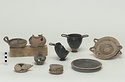
| Pyre 1 in Central House, Room XI, strosis 3. Sacrificial pyre with characteristic small vases amid carbonized twigs and bone.
Near north side of courtyard. This pit was cut slightly into strosis 3 (lot ... 1st quarter 4th c. B.C ... Pyre 1 in Central House, Room XI, strosis 3. Sacrificial pyre with characteristic small vases amid carbonized twigs and bone.
Near north side of courtyard. ... The pyre is approximately contemporary with the renovation of the house that initiated phase 3 in the first half of the 4th c., so it could be associated with that event. |
|
|