|
|
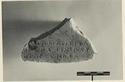
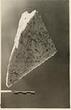
| Inscribed fragment.
Inscribed face only preserved.
Four lines of the inscription preserved, one letter of a fifth above.
Pentelic marble. Finished Found in late Roman context, probably disturbed, in Tholos ... 18 February 1938 ... Found in late Roman context, probably disturbed, in Tholos drain 3, between the Tholos and the Great Drain. |
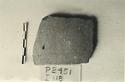
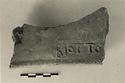
| Fragment from the wall of a large unglazed pot.
Scratched on the outside: Fill of drain trench, very late Roman context. Leica, 3-320 ... 29 June 1933 ... Fill of drain trench, very late Roman context ... Leica, 3-320 |
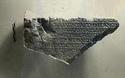
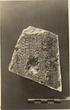
| Inscribed fragment.
Inscribed face, left edge and back preserved.
Nine lines of the inscription preserved.
Pentelic marble.
Cf. I 10 and related. Found in late Roman context in a well southwest of the ... 22 July 1947 ... Found in late Roman context in a well southwest of the Market Square, west of the Great Drain; box 3. |
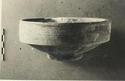
| Rim profile nearly straight, slightly incurving. Around rim just below lip a single grooved line.
Buff clay; red matte paint inside and out, partly covering the ring foot.
Late Roman. Rectangular drain ... 9-17 June 1933 |
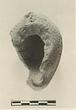
| Handle and parts of discus, rim and left side missing.
Herringbone pattern on rim, spoke motif or Mosaic candle-stick on discus; reverse, circular, with pediform stamp. Fish-tail at base of handle, and ... 13 May 1938 ... Type XXXIII of Corinth collection.
Late Roman ... Late Roman fill next to drain wall, with coins for the day, nos. 3-4, and L 3389-3395 (Σ 1878-1884). |
| Inscribed fragment.
Broken all around and behind.
Twelve lines of the inscription preserved, trace of thirteenth line.
Pentelic marble. Finished Found in late Roman destruction debris of large monument ... 13 May 1937 |
| Inscribed fragment.
Right side only remains.
Five lines of the inscription preserved, traces of sixth and seventh lines; stoichedon.
Hymettian marble. Found in late Roman destruction debris of large monument ... Early 3rd. century B.C. |
| Part of the base (or rim) of a coarse pot, stamped inside, right side up for a base.
Gritty red clay, unglazed.
The fabric could be Hellenistic, but the stamp on the rim suggests Roman procedure. May ... 23 March 1936 |
|
|