|
|
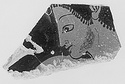
| Small piece from wall. Head and shoulder of youth, left. Relief contours; dilute glaze details, including sideburns, forelock incised.
Cf. Kleophrades Painter, Beazley (1933), Kleoph.Maler, pl. 14(3) ... 30 April 1952 ... Cf. Kleophrades Painter, Beazley (1933), Kleoph.Maler, pl. 14(3) and pl. 28(1). |
Wall fragment. Glaze streaky reddish brown and dull black on inside. Max. dim. 0.062. A. Ashmead, Hesperia 35, 1966, pl. 8:6.
Man or youth (lower legs, right foot frontal, left in profile). Preliminary ... Ca. 480 B.C ... The shin bone continuing to the inside contour of the leg occurs on a few late works by the Kleophrades Painter: Copenhagen 149, the youth leaning on the stele (ARV2 184, 27; Paralip. 340, 27); London, B.M. ... The Kleophrades Painter (ARV2 191, 99; Paralip. 341, 99). |
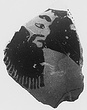
| From the shoulder of a large vase, glazed inside with thin black. No relief contours; the outline of the eye and the breast muscle drawn with relief lines. The eye full face, the angles slightly open; ... 16 February 1933 ... Circle of the Kleophrades painter? Cf. |
Shoulder and wall fragment. Traces of burning on inside. Max. dim. 0.116. A. Ashmead, Hesperia 35, 1966, pl. 7.
Herakles (head, upper torso, left arm with club, start of right arm outstretched) reclining ... Ca. 500 B.C ... The Kleophrades Painter (ARV2 one 125, 59; ARV2 189, 79; Paralip. 341, 79). |
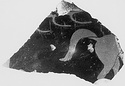
| Broken all around.
Rear part of Centaur moving right; with branch over his shoulder; trace of another figure at left.
(The Centaurs of the Kleophrades painter are not far off. Note also that the scale ... 29 May 1954 ... (The Centaurs of the Kleophrades painter are not far off. |
Wall fragment from near rim. Glaze slightly dull on outside. Max. dim. 0.052. H. A. Thompson, Hesperia 16, 1947, pl. 47:2; A. Ashmead, Hesperia 35, 1966, pl. 8:2.
Man (most of filleted head) to right ... Ca. 490 B.C ... The Kleophrades Painter (ARV2 186, 41; Paralip. 340, 41). |
Two non-joining wall fragments. Max. dim. a) 0.055, b) 0.077. A. Ashmead, Hesperia 35, 1966, pl. 8.
Fragment a preserves most of the filleted head of an old man (Phoinix) to left, holding a spear or staff ... Ca. 490 B.C ... Döhle (Klio 49, 1967 [ pp. 63--143], p. 105) thinks that 254 may come from a representation of the Mission to Achilleus, based in part by the presence of Phoinix in the same scene by the Kleophrades Painter on his hydria in Munich, inv. 8770 (Paralip. 341, 73 bis; Addenda 189). ... The Kleophrades Painter (ARV2 185, 38; Paralip. 340, 38). |
Three non-joining fragments: P 22490 of rim and start of wall; P 30996 of rim; P 13366 of wall and cul with stub of handle. Reserved line at top of rim on inside. Max. dim. P 13366: 0.105, P 22490: 0.083, ... Ca. 500-490 B.C ... For black glazed palmettes on the rims of red-figured calyx-kraters, see the following: two by the Kleophrades Painter decorated early in his career: Louvre G 48 + New York, M.M.A. 1978.429.1:a--v: there one-half of the rim has horizontal black-glazed palmettes, the other half, upright palmettes in reserve (ARV2 185, 33; Paralip. 340, 33; Addenda 187) and Tarquinia RC 4196, up-and-down palmettes (ARV2 185, 35; Paralip. 340, 35; Addenda 187); two by the Eucharides Painter, both drawn horizontally and also early in his career: Louvre G 47 (ARV2 227, 11; Addenda 199) and Louvre G 163 (ARV2 227, 12; Paralip. 347, 12; Addenda 199). 252 is closest to Louvre G 48. Black palmettes do not seem occur elsewhere on the culs of red-figured calyx-kraters, but they are known from two black-figured examples, both related to the Antimenes Painter: Syracuse, where a single palmette at each handle frames the figured composition (ABV 281, 18) and Louvre F 316 (ABV 281, 19). For the net pattern on the cul, though not reduced to a dot band as on 252, see Copenhagen, N.M. inv. 13365 by the Kleophrades Painter (ARV2 185,32; Paralip. 340, 32; Addenda 187) and Louvre G 47 by the Eucharides Painter; also Louvre CA 5950 (above, sub 249). |
|
|