|
|
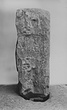
| Boundary stone ... Horizontal (normal) ... Hesperia 3 (1934), p. 64, fig. 56. |
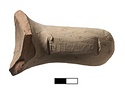
| Thick, similar to Rhodian; broken at curve.
Clay similar to Knidian, with thick light slip; inside of neck appears to be slipped.
Impression begins close to neck; long, shallow except at ends. Deposit ... Hellenistic ... Hesperia 3 (1934), no. 64. |
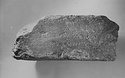
| Dedication fragment ... Horizontal (normal) ... Hesperia 3 (1934), p. 69, fig. 64. |
From a thin, straight-walled vessel. Decoration of conventionalized branch with leaves of thin clay and white paint alternating.
Metallic black glaze inside and out. Cistern. Leica, 4-338 ... 3-12 March 1934 ... Hesperia 3 (1934), no. E 64. |
| Broken at bottom and left side; preserved surfaces all rough picked, save for a recessed, more finely picked band, on which is the inscription.
Perhaps sanctuary of Herakles Alexikakos.
Pentelic marble ... Mid. 5th. century B.C ... Hesperia 3 (1934), p. 64, no. 56. |
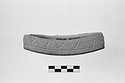
Typical curve.
Fairly coarse red clay, to greyish at core; traces of mica; slight traces of pinkish cream slip.
Askew and incomplete impression; worn. Cxt: see cxt notes of 7.vii.75 made for SRotroff ... 23 July 1931 |
| Lip fragment with wavy groove on flat rim.
Brown glaze inside; coarse pink clay, cream slip. Cistern. Leica, 96-3-6(5) PD 350 ... 1932 ... Hesperia 3 (1934), no. C 64. |
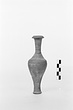
| Fusiform shape. The neck broken off but repaired. Rather fat body with definitely profiled shoulder below which is a trace of a white band.
Orange red clay, entirely covered with a thin, streaky dark ... 4 April 1933 ... Hesperia 3 (1934), no. A 64, p. 326. |
|
|