|
|
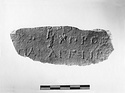
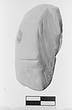
| Inscribed fragment.
Inscribed face only preserved.
Stoichedon.
Pentelic marble. Found in late Roman context (3rd.-4th. centuries A.D.) immediately beneath the water pipe above the exhedra, east of the ... 16 April 1935 ... Hesperia 29 (1960), p. 6, no. 6, pl. 5. |
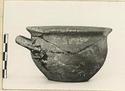
| One handle and fragments of lip missing. Flaring lip; small flat bottom.
Glazed inside and out, except for reserved zone inside of lip, on which are glazed lines. Glaze nearly gone.
Clay pinkish-buff ... 25 October 1956 |
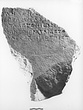
| Fragment of inscribed base.
Broken away on back and on both sides; top and bottom preserved.
Bottom finely picked; top smooth.
Part of five lines of the inscription preserved.
Pentelic marble. Found in ... 347/6 B.C. |
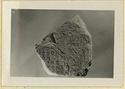
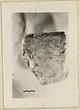
| Inscribed fragment.
Back lightly chisel gouged; right side seems preserved, though surface is badly weatherd.
Six lines of the inscription preserved; stoichedon.
Pentelic marble.
Transferred to the Epigraphical ... 5th. century B.C. |
| Preserved is the mold for a draped figure wearing a mask with gaping mouth and sharply projecting beard. His right hand is raised to his shoulder, as if to hold something carried on his back. He wears ... 18-21 October 1947 |
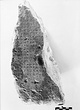
| Inscribed fragment of stele.
Inscribed face, smooth finished back and rough picked bottom preserved; broken elsewhere.
Twenty-one lines of the inscription preserved.
Pentelic marble. Found in modern wall, ... 29 February 1936 |
| Inscribed fragment.
Dressed top and right side preserved.
Two lines of the inscription preserved.
Pentelic marble. Found in the wall of the modern houses 650β/1 and 650β/5 (650b/1 and 650b/5), south of ... 30 December 1936 |
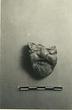
| A bearded mask.
The top broken away.
Mouth open; eyes not pierced.
Traces of red paint.
Red clay.
Cf. T 1468. Pit, disturbed.
Hellenistic-late Roman. Leica ... Card: early 4th c. B.C. |
|
|