|
|
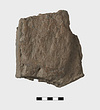
| Single fragment preserving part of two sides. Battered.
Roughly rectangular in shape with convex underside. On two opposite sides, vertical tool marks. Heavy. Porous, rough top surface. Oscar Broneer, ... 15 September 1932 ... Hesperia 2 (1933) p. 352. |
| Fragment of nozzle and rim.
Rim flat, slightly sloping towards center. Body, nearly straight sided.
Nozzle deep, long broad with rounded end.
Hard black glaze.
Pale red Attic clay.
Type VI of Corinth ... 17 June 1931 ... Hesperia 2 (1933), p. 198. |
| Fragment of nozzle and body.
Plain rim. Plain discus with central filling hole, very small. Double convex body. Nozzle triangular with channel from discus. Slightly raised base.
Red and black glaze.
Pale ... 16 June 1931 ... Hesperia 2 (1933), p. 202. |
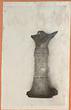
| Part of standard and oil bowl.
A heavy stem, slightly hollow in its upper part, rises from a saucer-like base, and at the top flares out to form a shallow oil bowl. A projection, now broken off, rose from ... 1931 ... Hesperia 2 (1933), p. 212. |
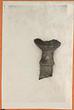
| Upper part only preserved.
On the top of a heavy slightly hollow stem rests a shallow oil bowl, its front pinched together to form an open nozzle. At its back is attached a vertical loop handle, fastened ... 10 June 1931 ... Hesperia 2 (1933), p. 212. |
| Upper part only preserved.
On the top of a heavy slightly hollow stem rests a shallow oil bowl. Below the bowl, the stem is encircled by a swollen ring. From the center of the bowl rose some projection, ... 1931 ... Hesperia 2 (1933), p. 212. |
| Open type; the curving sides pinched in at one end to form an unbridged nozzle. No handle. Stem pinched; broken off in the middle.
Light yellowish-green glaze on the inside of the body, and irregularly ... 20 July 1931 ... Hesperia 2 (1933), p. 212. |
| Nozzle and handle broken.
Flat rim, slightly depressed.
Double convex body, but without a sharp angle. On the left side of the body, a small unpierced knob.
Nozzle rounded. Vertical band handle.
Low base, ... 21 July 1931 ... Hesperia 2 (1933), p. 200. |
|
|