|
|
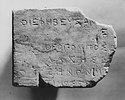
Fragment from bottom part of inscribed stele.
Pentelic marble. Found in modern foundation, in the southeastern part of the Market Square. Leica ... 20 February 1933 ... Hesperia 3 (1934), p. 63, no. 55. |
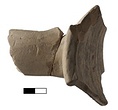
| Resembles the rising, less angular Rhodian type; thick; mended from two fragments.
Fine reddish-yellow clay, lighter near surface; Rhodian cream slip.
Impression broken away at left; very shallow and ... 15 July 1931 ... Hesperia 3 (1934), no. 63. |
Lip fragment with a single shallow groove on the rim.
Coarse clay with bits; gray-green as if from burning. Traces of a cream slip. Cistern. Leica PD 350 ... 1932 ... Hesperia 3 (1934), no. C 63. |
The handle and a little of the mouth only remain. Globular body; low neck with flaring lip; short strap handle.
Gritty, buff clay, fired yellow on the outside. Pithos. Leica, 4-333 ... 1932 ... Hesperia 3 (1934), no. D 63. |
| Base fragment ... Horizontal (normal) ... Hesperia 3 (1934), p. 68, fig. 63. |
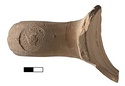
| Less angular shape than typical Rhodian.
Fine clay, yellowish, with small light red core; cream slip worn thin.
Impression incomplete round quarter of edge; slightly doubled. Par: Nilsson 1909 nr 244 ... 23 July 1931 |
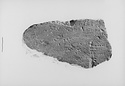
Inscribed fragment.
Part of a large block, rough picked along the bottom surface; the other edges broken.
The inscription is preserved only on a small area at the bottom; most of the surface has been broken ... 1933 ... Hesperia 3 (1934), p. 63, no. 53. |
| Inscribed fragment.
Broken all round; the front worn.
Parts of three lines of the inscription preserved.
Hymettian marble. Found in a modern wall, north of the western part of the Middle Stoa. Leica, 84-417 ... Early 4th. century B.C ... BCH 58 (1934), p. 91 ... Hesperia 3 (1934), p. 63, no. 54. |
|
|