|
|
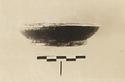
| Small open bowl on ring foot; thickened lip.
Black glaze somewhat peeled, especially on the floor.
Cf. Agora XII, no. 874. Well. Leica PD 845-e, DA 12767 ... 25 May 1937 ... Hesperia 18 (1949), no. 63, p. 328, fig. 5. |
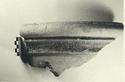
| Well or cistern curb? Fragment from mouth. The lip is finished with an ovolo, below which is a cavetto.
Gritty yellow clay. Unglazed, save for the cavetto which is painted red.
This and the preceding ... 1932 ... Hesperia 27 (1958), p. 172, n. 31 ... Hesperia 18 (1949), p. 121, fig. 5 ... Hesperia 3 (1934), no. |
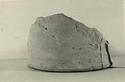
| Fragment from the mouth of a large pithos. The rim is flat and broad on top and finished on the outside with a cavetto between two ovolos.
The lower ovolo is decorated with a herringbone pattern between ... 1932 ... Hesperia 27 (1958), p. 172, n. 31 ... Hesperia 18 (1949), p. 121, fig. 5 ... Hesperia 3 (1934), no. |
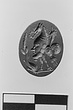
| Oval inset (seal) from bezel, bevelled.
Intaglio; bearded head, left, resting on birds' legs and provided cap, finished with a horse 's head at the top, the horse holding a wreath in its mouth. Symbols ... 8 April 1948 ... Hesperia 18 (1949), p. 226, pl. 46, 5. |
Ring foot; inset lip. Reserved: underside with glazed band and circle; junction of wall and foot. Handle-panels glazed.
Similar: P 19315 B 18:5 Hesperia, XVIII, 1949, pl. 39, 3; XX, 1951, pl. 73, 1 and ... Ca. 425 B.C ... Similar: P 19315 B 18:5 Hesperia, XVIII, 1949, pl. 39, 3; XX, 1951, pl. 73, 1 and P 10988 B 15:1 Hesperia, XVIII, 1949, pl. 93, 76. |
| Mended from many pieces and restored in plaster. Ring foot; plump body with wheel ridges below; two grooves at base of neck; round neck-mouth; band handle from below neck to well down on wall.
Dull purplish-black ... 22 March 1948 |
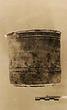
| Flat slightly projecting bottom, roughly finished, and lower part of straight sides preserved. Shallow wheel ridges around side.
Buff clay. Splash of brown wash on outside. Cistern, middle fill. Leica, ... 9-12 February 1937 |
| Large fragment of one side missing. A straight-sided jar with slightly inset flat foot, grooved near its outer edge. Two broad wheel-run grooves outside, just below lip, and two more on lower part of side ... 11 February 1937 |
|
|