|
|
A filling lying over a cobbled floor in a house-complex on the lower north slopes of the Areopagus.
Area in front of E-W retaining wall, just above cobble pavement, disturbed by coins and pottery as late ... 375-275 B.C ... A filling lying over a cobbled floor in a house-complex on the lower north slopes of the Areopagus.
Area in front of E-W retaining wall, just above cobble pavement, disturbed by coins and pottery as late as the 3rd c. ... SS 367 listed on deposit list but actually from topmost layer in this area, not 'just above cobble pavement'. |
Evidence of stratification into five layers, although joins between the layers. Layer VI added when the construction of the Roman building above required it. No subdivisions assigned.
Flask-shaped cistern ... Early 3rd-late 2nd c. B.C. |
| Eugene Vanderpool ... Grave (adult female). (In some records as Grave XXXI).
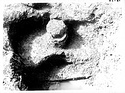
The tomb was partly destroyed in antiquity; there are sherds of all periods down to Late Roman (and later) note din the fill immediately above it ... Middle Geometric I ... The tomb was partly destroyed in antiquity; there are sherds of all periods down to Late Roman (and later) note din the fill immediately above it. A modern well was partly cut into the northeast portion of the tomb as preserved, and an ancient block, reused in a modern wall, was founded directly on bedrock just to the southwest of the tomb.
... As encountered, the cinerary urn, largely destroyed in antiquity, was bedded in the disturbed upper filling of the well. |
|
|