|
|
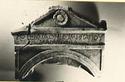
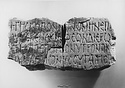
| Inscribed fragment.
Broken all around.
Fragment preserves part of crowning moulding.
Hymettian marble. Found in early Byzantine context over a Byzantine house, east of the altar of Ares. Leica ... 5 June 1950 |
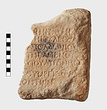
| Inscribed fragment of early Christian Epitaph.
The left edge preserved; other edges broken.
Part of three lines of the inscription preserved.
Pentelic marble. Found in Turkish well, east of the Southwest ... 21 April 1934 |
| Inscribed fragment of grave stele.
Broken below.
Fragment preserved pediment, inscription and part of background for relief.
Both lettering and treatment of stone rather crude. Rough picked back. Two cuts ... 4 April 1951 |
| Inscribed fragment.
Inscribed face and part of right side preserved; also sloping top with cutting at edge of break.
Probably a Herm.
Seven lines of the inscription preserved.
Pentelic marble. Finished ... 13 June 1947 |
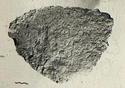
| Inscribed fragment.
A hunk of stone with letters on a very rough surface. Edges and back very rough, but may be contemporary with inscription.
Conglomerate; mortgage Horos.
Five lines of the inscription ... 13 June 1947 |
| Inscribed fragment.
Letters inscribed on a partially smoothed down broken surface; back worn smooth; worn breaks at sides and top, in crude pediment form, may be contemporary with inscription; broken at ... 1st. century B.C. |
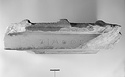
| Inscribed fragment.
The left part of a crowning member for a monument with recessed niche, and with horizontal cornice, not pediment.
Broken at right; top roughly picked with front sloping down and small ... 30 April 1947 ... The left part of a crowning member for a monument with recessed niche, and with horizontal cornice, not pediment.
... Dowel hole on bottom surface at left; shallow circular cutting on top at edge of break at right.
... Found in the wall of the Byzantine House I east of the Great Drain, in the industrial area. |
| Inscribed fragments.
Fragment Π 51, only face and back preserved; the back has a series of mouldings with a highly polished surface.
The inscription perhaps represents the later use (?).
Fragment Π 155 ... (Π 51) 31 December 1934
(Π 155) 23 February 1935
(Π 170) 28 February 1935 |
|
|