|
|
Drain Trench at 62/ΜΗ.
The presence of a number of fairly well preserved vases of good quality suggested to the excavator the possibility that the cutting might once have contained a burial. No skeletal ... 325-300 B.C ... Drain Trench at 62/ΜΗ.
The presence of a number of fairly well preserved vases of good quality suggested to the excavator the possibility that the cutting might once have contained a burial. ... "Early Hellenstic, but after 4th c."
Grid 61/ΜΕ-62/ΜΘ |
Dug as Tholos Trench V, Room E, burnt filling of plundered wall trench of S wall of court. See also lot Ζ 484 ... Late 6th c. B.C. |
Dug as Metroon Porch Pit A and Pit C (layers II and III). ... 7th-6th c. B.C. |
Diameter 0.95m; water level -9.10m.
Plais shaft cut in stereo from bottom of slender flask-shaped cistern. Scanty fill from house destruction in 5th c. A.D.; Christian lamps; unfinished statuette of Castor ... Late Roman ... Scanty fill from house destruction in 5th c. A.D.; Christian lamps; unfinished statuette of Castor ... Coins:
16 April 1948 #35
27 April 1948 #62 |
Destruction debris in L.R. water basin, 6th-7th c. A.D, set against back wall of South Stoa II ... 6th c. or 7th c. A.D ... 6th c. or 7th c. A.D ... Τ:62-64/ΚΒ-ΚΓ |
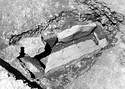
| Susan I. Rotroff ... Burial 3 beneath the floor of the Stoa Basileios. It consisted of a rectangular pit cut into bedrock to a depth of 0.44m, lined on all sides and covered with an admixture of narrow stone slabs of soft ... Final Mycenaean/Submycenaean ... Hesperia 44 (1975), pp. 372-374, pl. 83,c ... Agora XXXVI, Tomb 62, pp. 416-420, 549, figs. 2.290-2.292, 2.298-2.302. |
Well at 115/ΣΤ (all the 5th c. fills of 116/ΣΤ). The lower part of the shaft contained a heavy deposit of pottery and other objects of the late archaic period, both coarse and finer wares; probably a post-Persian ... Ca. 500-480 B.C.-Roman |
Nb page 5044: Great shapeless pit with a well (62/Ξ) at its bottom which we were unable to dig because it was too dangerous. Fill in the pit was of sand and white ash. The finds and pottery 4th. and perhaps ... Late 4th.-early 3rd. c. |
|
|