|
|
Scanty remains of use fill in lowest 0.30m. with Byzantine dump above ... 400-350 B.C ... Scanty remains of use fill in lowest 0.30m. with Byzantine dump above. |
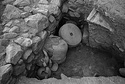
| James Artz Pirisino Daniele Kylindreas Miltiades ... Excavation in Room 3 of ΒΘ West revealed 5 ceramic vessels in a row against the eastern face of Wall 12. 3 complete vessels (ΒΘ 122, 124, and 125) were catalogued, along with the base of a plain glazed ... 9th-11th c. A.D ... The primary types of glazed Byzantine pottery found in the fill included green and brown painted ware, plain glaze ware, Constantinople white ware, and monochrome glaze.
... The fragmentary remains of a ceramic pithos (ΒΘ 178) were revealed after the removal of a reused threshold block above the pithos. ... We also uncovered fragments of a Byzantine vessel at an elevation of 53.590m, which were later removed entirely (ΒΘ 302).
|
Rodney S. Young ... (E.L. Smithson: Grave XXXVI:PG). Early fill over bedrock. No remains.
Two fragmentary unburned vases were found together on bedrock, beneath Roman and Byzantine fill. Disturbed earth over bedrock for several ... Early Protogeometric ... Early fill over bedrock. No remains.
Two fragmentary unburned vases were found together on bedrock, beneath Roman and Byzantine fill. |
| Not completely excavated due to instability of chamber walls and water. Sherds of all periods - Greek, Roman and Byzantine - were found in it [nbp. 424].
Re-examined in 2010. Photos and notes on NB pages ... 10th c. A.D ... Sherds of all periods - Greek, Roman and Byzantine - were found in it [nbp. 424].
... Around its mouth is the remains of a square platform of tile, stone and mortar, with a segment of a square ceramic drain running along the northeast. |
| Eugene Vanderpool ... Rectangular pit, oriented east-west, cut party into filling of Early Protogeometric pit-well (I 18:4), to a preserved depth of about 0.30m. A late Byzantine wall founded below the floor of the grave destroyed ... Middle Geometric I ... A late Byzantine wall founded below the floor of the grave destroyed the entire eastern half of the earlier burial. ... Reanalysis of the human remains in 2000 suggested a child aged 12-14 years at death. ... In the process of studying the skeletal material, the fragmentary remains of two further individuals were noted, including the secondary or disturbed remains of an adult inhumation (AA 52b), as well as those of a cremated adult (AA 52c). the position or even presence of these two individuals was not noted in the field, and both are probably intrusive, particularly as the grave was disturbed by later activity.
|
| Margaret Crosby ... Grave 1 (Grave XXVI: EG) Urn cremation (trench-and-hole), adult male?
[JP]
Boots or Booties Grave. Near the west branch of the Great Drain, about 100m to the southwest of the Agora horos inscription ... Early Geometric I ... The ground level at the time of the burial must have lain somewhat higher; a deep disturbance of Byzantine times had gone to bedrock in the area of the grave and destroyed all evidence as to the original levels. ... After cremation the remains of the bones, together with the jewelry which had probably served to fasten the clothed, were gathered up and placed in an amphora. |
|
|