|
|
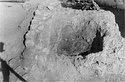
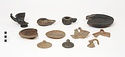
| Pit with traces of burning ... Probably 3rd qtr. 5th c. B.C ... Pit with traces of burning. |
Pit on north slope of Kolonos Agoraios. Traces of burning in the dirt fill; mixed in with this many fragments of fine pottery ... Ca. 450-420 B.C ... Pit on north slope of Kolonos Agoraios. Traces of burning in the dirt fill; mixed in with this many fragments of fine pottery. |
Pit at 57/ΚΑ; small pit on the lower north slope of the Areopagus, measuring 1.05x0.80mx0.80m deep. There were traces of burning and a few bones in it, since none of them are recognizably human it is probably ... 480 - 470 B.C ... Pit at 57/ΚΑ; small pit on the lower north slope of the Areopagus, measuring 1.05x0.80mx0.80m deep. There were traces of burning and a few bones in it, since none of them are recognizably human it is probably a refuse pit rather than a grave. |
Cistern at 53/ΝΕ, bottle-shaped, stucco-lined, in the east aisle of the peristyle of Roman House H (courtyard of Greek House G, just west of andron).
Lower diameter 2.73m.
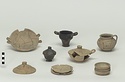
Homogenous fill all apparently ... Into early 2nd century B.C ... Cistern at 53/ΝΕ, bottle-shaped, stucco-lined, in the east aisle of the peristyle of Roman House H (courtyard of Greek House G, just west of andron).
... Homogenous fill all apparently deposited at one time, traces of burning on much of the pottery. No discernible period of use fill.
Particularly fine series of Megarian bowls. |
Filling under North-South Road surface, apparently to raise the level of the road as thickness of fill varies depending on height of road. Fill sits on earliest, cobbled road layer. The road surface set ... Mid-6th c. B.C ... Filling under North-South Road surface, apparently to raise the level of the road as thickness of fill varies depending on height of road. ... The road surface set upon this fill consists of cobbling to the west and a hard packed surface to the east ... Some traces of burning. Much of the pottery is decorated with black figure. |
| Initially was recorded as disturbed saucer grave, but identified as pyre by SIR.
Found by gardener washing out of scarp during the winter rains. The location is just south of an east-west road; there ... 1962 ... Found by gardener washing out of scarp during the winter rains. The location is just south of an east-west road; there were traces of houses in this general area. There are signs of burning on some pottery. |
| Pyre in Room 8 of Roman House H. Concentration of artifacts, bone, and flecks of carbon in stratum, no pit discerned. the pyre lay within a red fill apparently contemporary with it, but with some later ... 300-290 B.C ... Pyre in Room 8 of Roman House H. Concentration of artifacts, bone, and flecks of carbon in stratum, no pit discerned. the pyre lay within a red fill apparently contemporary with it, but with some later intrusions; no trace of a floor above it survives. ... The pottery shows traces of burning. |
Well A (depth 10.20m, diameter 1.04m, water level 4m) outside the SW corner of the market square, to the east of the north-south road.
At the bottom of the well were scanty remains probably from a period ... Ca. 425-375 B.C ... Well A (depth 10.20m, diameter 1.04m, water level 4m) outside the SW corner of the market square, to the east of the north-south road.
At the bottom of the well were scanty remains probably from a period of use, but without whole water jars; above this lay a heavy deposit of mud, containing little pottery; the dumped filling in the top of the well was extremely fragmentary and carried considerable traces of burning. |
|
|