|
|
Two non-joining fragments; profile complete.
Low ring foot. Plain rim rounded on top; raised ridge on wall outside. Decoration inside: central palmette, six linked palmettes, enclosed ovules, linked palmettes, ... 430-420 B.C. |
Ring foot. Steep wall. Lid flat on top with reel-shaped knob. Reserved: resting surface and underside, resting surface and inside of lid and underside and top of knob, the latter decorated with two glazed ... 475-450 B.C. |
Wall fragment. Glaze streaky reddish brown and dull black on inside. Max. dim. 0.062. A. Ashmead, Hesperia 35, 1966, pl. 8:6.
Man or youth (lower legs, right foot frontal, left in profile). Preliminary ... Ca. 480 B.C. |
Handle, most of bottom, and half of body missing.
Flat resting surface. Slight groove at junction of foot and underside. High, nearly vertical lower body. Convex shoulder offset from short, tubular neck ... Context of 150-86 |
Handles missing.
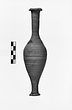
Slender body on disc foot; tall slightly spreading neck with heavy angular rim. Hard fairly clean red clay, gray at sur- faces. Decoration in red and white for bands on neck, shoulder ... Context ca. 375-350 B.C. |
Wall fragment. Max. dim. 0.097.
Nude woman (head, lower legs missing) moving to left, carrying an amphora with a bail handle (a little remains at each side) from which water pours into a laver (part of ... Late 6th or early 5th century B.C. |
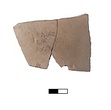
| Broken all around. Mended from two fragments. Fragment of amphora body with black paint letters.
Patronymic misspelled with extra syllable or double Σ:
Reddish-buff clay. Layer Θ. 909 Leica ... 4 July 1970 ... Agora XXV, no. 653, pp. 8, 11-13, 17, 99, fig. 21. |
| Gray clay streaked with brown. Well. Leica, 99-23-8 ... 16 April 1932 |
|
|