|
|
Fragment of archaic figure, seated. Head and limbs missing. Red, white, and tawny yellow paint. Munsell (fabric) 5 YR 6/4 light reddish brown; (paint) 10 R 4/4 weak red, 2.5 Y 6/8 olive yellow, and 8/N ... 17 October 1932 |
Plate.
Most of foot and part of wall preserved; badly shattered and flaking.
Low ring foot; broad, flat resting surface; flat underside. Sloping wall of fairly deep plate. Very porous, white core (2.5Y ... Context of late 2nd century after Christ |
| Fine buff clay, slightly micaceous. Nb. No. 3. Trench A, Assembly Place; filling of Period III. ΘΑΣΙΟΝ ΔΑΜΑΣΤΗΣ ΘΡΑΣΙΠΠΟΣ 437 ... 13 Mar 1931 |
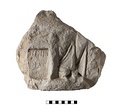
| Fragment from bottom of inscribed grave relief.
Back rough picked, bottom somewhat more smooth top and sides broken.
To left, high chair seat faces right; drapery falls back a little between the front ... 4 February 1932 |
Moldmade Bowl.
Wall fragment.
Moldmade body. Parts of two petals or leaves, diagonally ridged, with heavy, dark central ribs. Very pale brown fabric (10YR 8/3); shiny, pale aquamarine exterior surface, ... Context of before ca. 180 |
Bowl and lower part of stand missing; much of flange chipped away.
Hollow, vertically grooved stand, flaring widely to bottom. Molded flange at base of bowl decorated with incised cable above dotted ovolo ... Late 2nd to 1st century? |
Half of rim and part of body alone preserved.
Straight sides; flat top with groove around the edge. Very small filling hole. Pierced lug on left side.
Clay: fine gray (burned); red brown glaze inside ... 1931 |
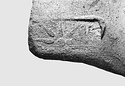
| Cf. Pridik (1917), pl. VIII, 14. Par: device like that of Pridik 1917, Pl 8, 14 but diff stp(VG)*
Dte: poss period I(VG)*
Rdg: Bon 1957 nr 744 w/ rdg =HROSTRATOS= (prob wrong)(VG)* Finished Late Roman ... 25 February 1937 |
|
|