|
|
Part of soft clay bowl with reddish brown slip. Inscribed inside. Spelling NEOKΛOΣ. Oscar Broneer, Nb. No. 4. 179 88-401 ... 31 May 1937 |
Clay fine, buff, soft. Head missing. Traces of white slip. Pin hole beneath on level bottom. Not carefully modeled.
Almost identical with Agora T IIII which is from Late 5th century context. From the ... Probably late fifth century B.C. |
Rim chipped.
Flaring foot, convex to outside; grooved resting surface; nippled underside at slight angle to inner face of foot. Reserved band at junction of foot and body. Four closely grouped palmettes ... 325-300 |
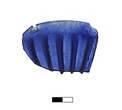
| Only a fragment from the rim and side wall remain.
The outside of the moulded wall is heavily ribbed up to a plain band which encircles the top.
Deep blue glass. Agora sample no. 281. Well on slopes of ... 3 May 1934 |
Mended from many fragments; more than half preserved. Central knob handle.
Clay micaceous, red, much blackened inside. Remains of slip. Unglazed.
Cf. Agora XXXIII, no. 732. Pithos. Leica ... 28 April 1932 |
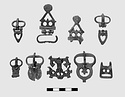
| A small buckle with a loop and a solid surface with two loops for attachment behind, and a tongue. Grave 10, by the heart. 80 Leica, XLIII-100, LVII-93, 83-321, 83-641 ... 2 May 1934 |
Most of handle and parts of foot, underside, and body restored.
Low foot; flat resting surface; flat underside with some string marks still visible. Straight lower body, convex shoulder. Tapering neck ... 150-110? (Roman context) |
| Rising shape.
Typical clay.
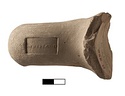
Neat impression. Finished Μενεκράτους Leica ... 29 February 1932 |
|
|