|
|
Foot missing.
Petal ribbing, joined at the top by arcs; two light grooves on lowest part of wall. Two ring handles. Ridge offsets wall from neck, light groove beneath ... Ca. 425 B.C. |
WT 242. Nb. No. 7. Wall Trench K, to W of Wall. ΕΠΙ ΣΤΡΑ
ΤΟΚΛΕΥΣ
ΔΙΟΝΥΣΙΟΥ 1510 ... Late 2nd century to 86 BC |
| Rather broad; level. Badly made and since damaged; string marks along edge, apparently made in wet clay.
Coarse red clay, with large grey core; remains of slip whose color is at present pinkish-grey ... Hellenistic but certain not early than 2nd century B.C. |
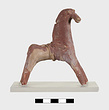
| Mended from two pieces (head and body). Left foreleg and lower parts of other legs missing; also collar strap across chest, where a broad stripe in lighter red extends from the broken ends of the strap, ... 22 April 1932 |
| a) body, b) part of bottom, c) part of lid, d) handle. Pyxis: about two-thirds of wall and complete profile preserved; partly restored in plaster. Lid: about half preserved; completely restored in plaster; ... 31 July 1968 ... Agora XXXVI, no. T23-3, pp. 222, 224, fig. 2.133. |
Shoulder and body fragment. Thin, streaky reddish brown glaze on inside. Max. dim. 0.057. Choes and Anthesteria, p. 89, cat. no. 224, fig. 221.
Boy (legs missing) to right, carrying a chous in his right ... Late 5th century B.C. |
About half of rim and upper wall preserved; partly restored.
Pale, micaceous fabric (7.5YR 7/6); shiny black glaze, mostly missing.
For fabric and glaze cf. 263, 264, 593, and P 6764 (Agora XXII, no ... 225-200 ... For fabric and glaze cf. 263, 264, 593, and P 6764 (Agora XXII, no. 224, pp. 71--72, pl. 44 [F 13:3, upper fill]). |
Wall fragment. Thin reddish brown glaze on inside. Max. dim. 0.044.
Part of figure (drapery), to right, perhaps seated.
672 is Meidian. Cf. the drapery of Hygeia on Florence 81948 (ARV2 1312, 1; Paralip ... Late 5th century B.C. |
|
|