|
|
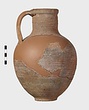
| Mended from many pieces; handle and fragments of body missing. Round mouth; thickened lip. Ribbing on neck and body.
Rather coarse brown clay, fired dark at core like Byzantine. Thin fabric. Unglazed ... 6 April 1937 ... Agora V, no. M 227, p. 105, pl. 27. |
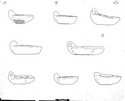
| On rim, double row of concentric circles; somewhat defaced.
On discus, seated lion, facing right; two oil holes.
Handle, plain, narrow. Nozzle, plain, with channel to neck.
On reverse, single circular ... 29 July 1931 |
A. thorax.
B. plain. Around catch basin. Leica ... 25 February 1937 ... Agora X, p. 108, pl. (27), no. L 227 e. |
Small piece from the bottom.
It is surrounded by two grooves. Within the grooves possibly the letters: "[Λ] Ε".
Unglazed, burned gray clay.
Type XXVIII of Corinth collection.
Cf. Corinth IV, ii, p. 277, ... Late 3rd.-4th. century A.D. |
A: cuirass in incuse circular stamp.
B: plain.
Cf. IL 903, 831 etc. Entered as coin no. 27. Martyr over steps at S.W. corner of Middle Stoa. 1886 Leica ... 24 April 1948 ... Agora X, p. 108, (pl. 27), no. L 227 d. |
A: thorax.
B: very bumpy, but no clear trace of impression.
Cf. IL 888, 903. Not fill inside drain. Middle drain to north of Building C; firm gravel over bedrock, with coins. 2568 Leica ... 26 May 1938 ... Agora X, p. 108, pl. (27), no. L 227 c. |
| Inscribed block.
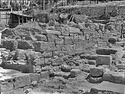
Preserved is a large rectangular block, the edges much broken and worn. As built into the wall, the inscribed face is right side up.
Moulding preserved in part along the upper edges to ... 2 March 1938 |
About a third of the wall and rim preserved with one handle attachment; none of the foot. Heavy type, the lip offset and sharply flaring. A fragment of the rim does not join. A scraped groove above the ... 19 April-5 May 1935 |
|
|