|
|
Half of rim and upper body, pieces of lower body, most of one handle, and part of the other missing.
Scraped groove in resting surface; concave underside. Scraped groove at junction of stem and body ... Ca. 300 |
Much missing, including both handles.
Moulded ring foot; raised rings on underside. Reserved: a band between the two rings and the space within the inner ring with two circles and dot. Groove above junction ... Ca. 420 B.C. |
| Handle and small amount of wall preserved. Vertical handle from rim to below rim.
Shiny black glaze.
Cf. Agora XII, nos. 360-363. Catalogued 20 August 1984. Pit. 965 84-22-21, 85-32-11, 87-21-15a ... 27 June-5 August 1972 |
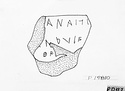
| Fragment from wall of plain pot.
Graffito written on inside after break:
Red-buff clay, unglazed. Well; dug stereo fill, 4th. c. B.C. 746, 7820 Leica, 86-38 PD 790 ... 11 July-7 August 1947 |
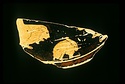
| From a lid with flanged rim. On a ground line a little in from the edge on top, a hare right, between two partly preserved lions. Sketchy drawing; relief contour for the hare's paws.
Black glaze inside ... 22 April 1935 |
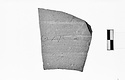
| Single coarseware wall fragment, broken all around.
Incised letters on exterior surface on two lines, broken off at left side.
Micaceous orange fabric, buff fabric; some inclusions, medium-fine grained ... 28 July 1997 |
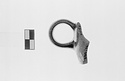
Eros.
Head, wings, left forearm, spout, and chalice missing.
Frontal body of plump figure. Wings originally attached at shoulders.
Left arm raised, right arm bent across chest, grasping chlamys at neck ... 200-175 |
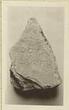
| Fragment of inscribed grave stele.
The edges broken but the back, rough picked, preserved.
Parts of four lines of the inscription preserved.
Hymettian marble. Found in late Byzantine context, south of ... Ca. 400 B.C. |
|
|