|
|
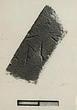
Left to right. Γάες
If this is a genitive of Gaia, as Blegen suggested, it is surprising. Ge and its forms are normal in Attic epigraphy, while Gaia is poetic. Votive dump. Γάες |
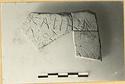
| Joins P 17950. Small wall fragment of plain pot.
Inscribed outside. Red gravelly fill under wall B, ostrakon fill. 8330 Leica ... 20 October 1949 ... Agora XXV, no. 370, pp. 15, 71. |
| From the wall of a large plain amphora?
Incised outside:
Pale greenish buff clay.
Joins P 20412. Red gravelly fill with kalikia. 4976 Leica ... 10 June 1947 ... Agora XXV, no. 370, pp. 15, 71. |
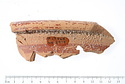
| Mended from many small fragments. Rim piece of a semi-glazed krater, badly broken.
Incised inside:
Red glaze inside, on rim, and for band outside. Finished Red gravelly ostrakon fill under ΝΘ-Ξ wall ... 13 June 1947 ... Agora XXV, no. 372, pp. 15, 71. |
Base preserved.
Graffito on bottom. Complete after purchase.
Clay: fine buff; black glaze. Assembly Place - filling of Period III. Σατύρο(υ) ... 1932 |
Ring foot. A sharp angle at junction of floor and wall. Broad projecting rim, flat on top and with a vertical outer face. Reserved: the resting surface, a zone around the wall. the top and the vertical ... Ca. 450 B.C. |
| The writing end broken away; the eraser end slightly curved. Rectangular rockcut shaft (no. 435). Leica, XXIV-47 ... August-September 1932 |
Handles, foot, stem, and three-quarters of upper bodymissing.
Thin stem. Pointed lower body with scraped groove below handle attachment. Two antithetical dolphins preserved (probably originally four), ... 290-275 |
|
|