|
|
| The end of an axe or hammer, bored vertically for a handle.
Hard gray stone, highly polished. Earth from Well 15; Mycenaean. Leica ... 29 March-3 April 1939 |
One-fourth of upper wall missing.
Scraped groove in resting surface; concave underside. Tapering stem. Scraped groove at junction of body and stem and below handle attachment. Lip very thin, as in cup-kantharos ... 290-275 |
Three non-joining wall fragments. Glaze fired greenish on fragment d. Max. dim. a) 0.087, c) 0.03, d) 0.122. E. Vanderpool, Hesperia 15, 1946, pl. 37:53.
Satyr to right, playing the aulos. Fragment a ... Early 5th century B.C. |
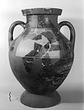
| Horse-head panel type. Mended from many fragments and restored in plaster. Swelling body with greatest diameter above center. Cylindrical vertical handles neck to shoulder. Heavy flat-topped rim. Body ... 1 March 1932 |
P 18586 a, b
Body (b) mended from seven fragments, lid (a) from ten fragments, with small areas of both restored; burning inside body and inside and outside lid.
Flat underside with string marks. Fairly ... 290-270 |
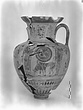
| Foot broken off; small pieces missing from body and lip; and one handle. Eggy body; narrow neck marked off above and below by light ridges; broad echinus lip; high ridged handles. Above the foot, a raised ... 23 May 1938 |
Half of rim, parts of wall, and part of one handle restored.
Scraped groove in resting surface; conical underside.Groove at base of body and scraped groove below handle attachment. Slightly incurved rim ... 290-275 |
| One side missing with a little over half the rim; base chipped. All over glaze, poor quality and much peeled, save on slightly rising under-surface and on flat top of lip.
Cf. Agora XII, no. 923. Rectangular ... August-September 1932 ... Agora XII, no. 923 ... Hesperia 15 (1946), p. 325, no. 290. |
|
|