|
|
Small parts of rim and wall restored.
Flaring ring foot; rounded resting surface; nippled underside.
Deep lower body, concave and inclined upper body; no groove in wall.
Ivy-leaf thumb rests. Olive ... 250-240 |
| Moulded.
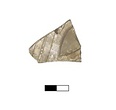
On body (?) raised horizontal bands; on rim, leaf pattern in relief.
Opalescent white glass. Cistern shaft.
1st c. B.C. Leica, XXXIII-28 PD 505, PD 2023-33 ... 14 May 1935 |
| Upper part of a figure.
Head missing. Broken in a slanting line from the waist to the right thigh.
Right arm at shoulder, left arm below elbow. At the back, the upper part of a rectangular firing hole ... 29 July 1931 |
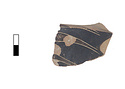
| Single wall fragment from closed shape, broken all around. Large but indistinguishable figure. Locks of hair indicated with incision and added red.
Early 6th c. B.C.
Cf. P 290 (Agora XXIII, no. 14 et ... 22 July 1994 ... P 290 ... Agora XXIII, no. 14 ... Hesperia Suppl. 46 (2011), p. 195, no. 22, fig. 38. |
Fish-plate.
Segment of plate from rim to edge of depression.
Low, flaring ring foot; broad, beveled resting surface; convex underside. Concave floor. Groove around depression. Narrow, heavy rim meets ... Context of before ca. 180 |
Mended from many pieces; large portions of rim and body missing.
Buff clay. Light green glaze within and dark brown without. Unglazed beneath base. Square well, lower middle. Leica, XXIII-46 ... 19 April-4 May 1933 |
Handle and part of rim.
Slightly flaring rectangular thumb rest, with spur below.
Thunderbolt on thumb rest; union jack on vertical section of handle; parallel lines on spur. Shiny black glaze.
Similar: ... 225-210 |
Wall fragment with start of base. P.H. 0.03; max. dim. 0.096; Agora XXI, p. 33, F 46, pl. 12.
A bit of the figured decoration remains, but it is difficult to know what it is, perhaps a large stone(?) ... Ca. 500 B.C. |
|
|