|
|
Fillet at junction of stem and foot. Reserved: outer face of foot, resting surface, center of stem inside with circle and dot, handle-panels. Thickened rim. Added red on fillet. Glaze fired gray in parts ... 525-500 B.C. |
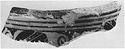
| Part of a great krater on a stand; preserved, part of top of stand and floor of krater. Inside, thin reddish glaze. Around top of stand, quadruple black band; below, top of head and one wing of a siren ... 22-28 February 1935 ... Agora XXIII, no. 400, fig. 12, pl. 39. |
Center of floor missing.
Ring foot; grooved rim. Unglazed.
Also unglazed with similar profile, P 11769 H 12:6 ... 425-400 B.C. |
Ring handle missing.
Three grooves and ridges around the top; a groove at the shoulder. Strainer top. Low flat base, slightly projecting. Lower part of wall, end of spout, and handle glazed; shoulder ... 400-375 B.C. |
Ring foot. Rim flat on top, sloping inwards. Reserved: resting surface, underside with two glazed circles and central dot, and junction of foot and wall.
The following have reserved undersides: P 11773 ... 425-400 B.C. |
Lid missing.
Low ring foot. Deep wall, inset. Reserved: resting surface and underside with glazed circle and central dot.
Similar and with lid missing, Cambridge GR. 12. 1854, not certainly Attic ... 425-400 B.C. |
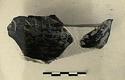
| Two non-joining fragments from near base of column krater, put together with plaster. Rays outside, black glaze, worn, inside.
Incised inside:
Cf. P 17660. Ostrakon area. 5220 Leica ... April-June 1947 ... Agora XXV, no. 400, pp. 12, 74. |
Wall fragment with turn of shoulder. Max. dim. 0.046. Choes and Anthesteria, p. 79, cat. no. 166, fig. 231.
Woman (head, torso to waist, half of arms) leaning to right, arms outstretched. She wears a ... Ca. 400 B.C. |
|
|