|
|
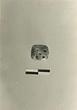
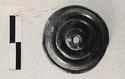
| Edges and corners smoothed down to curves.
Standard disk markings, made by deep drillings, probably once filled with some contrasting color. Area south of east-west Roman wall, layer II, above 4th c. B.C ... 13 March 1952 ... Area south of east-west Roman wall, layer II, above 4th c. B.C. hole. |
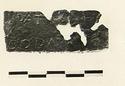
| Several joining fragments. Complete when found but partly disintegrated in cleaning. In the upper right corner, the dikast 's section letter Z (?), lost in cleaning.
Inscribed.
Bronze rectangle.
4th ... Card: 3rd of 4th c. B.C ... 4th c. B.C. hole. |
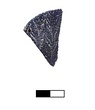
| Fragment from the side of alabastron-shaped jar (?).
Broken all around.
Molded, core-formed. Feather pattern inlaid on outside of curved surface.
Dark blue glass. Area south of east-west Late Roman Wall: ... 11 March 1952 ... Area south of east-west Late Roman Wall: dumped bedrock on east side of 4th c. hole.
4th c. B.C. |
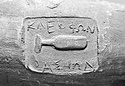
| Part of rim preserved.
Rectangular stamp with alabastron in centre. Cxt: hole N of Room 4* Finished In rectangular cutting, 4th century B.C. fill. Κλεοφῶν
vaseI
Θασίων 3962 Leica ... 29 May 1953 ... Cxt: hole N of Room 4* ... In rectangular cutting, 4th century B.C. fill. |
| Flat on one side, convex on the other.
The flat side is grooved, the convex side ribbed.
Round, with large hole through center. Rubbish pit.
4th c. B.C. 4348 Leica PD 2112-13 ... 26 April 1947 ... Round, with large hole through center ... Rubbish pit.
4th c. B.C. |
| Handle and tip of nozzle missing.
Concave disk foot, round body, plain rim around filling hole offset by ridge.
Unglazed outside, fired gray; peeling black glaze within.
Type 24 of Agora collection.
Late ... 27 July 1973 ... Concave disk foot, round body, plain rim around filling hole offset by ridge.
... Late 5th.-early 4th. century B.C. |
| Roughly cut perimeter. Hole in center has been smoothed by an axle. Traces of black glaze on both sides.
Buff clay. 0.64-1.06 m. below highest point of north wall 4th layer below 5th c. B.C. Hieron floor ... 2 August 1967 ... Roughly cut perimeter. Hole in center has been smoothed by an axle. ... 4th layer below 5th c. B.C. Hieron floor.
0.64-1.06 m. below highest point of north wall. |
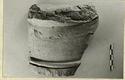
| Nearly one-quarter of the circumference and the full height preserved, of a base with moulded rings at its bottom; the wall pierced by two small round holes. A round hole through the center of the flat ... 20 October 1947 ... A round hole through the center of the flat floor above.
... South of House R, wall foundation; 4th.-3rd. c. sherds in foundation. Context 4th. c. B.C. |
|
|