|
|
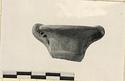
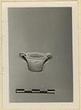
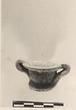
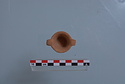
| Intact. Flat under surface, sharply flaring rim. Two vertical strap handles attached on rim and near base.
Unglazed. Orange buff clay. Cistern. KXX5. 5061-5063 Leica ... 5-9 August 1968 |
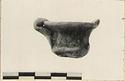
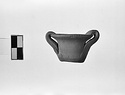
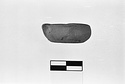
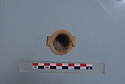
| One handle missing, otherwise intact. Flat under surface, sharply flaring rim. Two vertical strap handles attached on rim and near base.
Unglazed. Orange-buff clay with iron corrosion. Cistern. KXX5 ... 5-9 August 1968 |
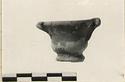
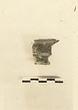
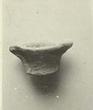
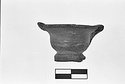
| Mended. Chips missing. Flaring base, flat underside. Concave-convex side walls. Handle projections at rim.
Thin brown wash, peeling. Buff clay. Cistern. KXX5. 5061-5063 Leica ... 5-9 August 1968 |
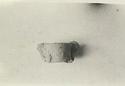
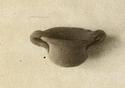
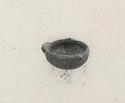
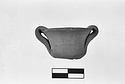
| Intact. Flat underside. Bulging side wall, low. Three lugs on rim.
Orange clay. Cistern. KXX5. 5061-5063 Leica ... 5-9 August 1968 |
| Very crduely made; the handles simply lumps of clay, the walls flaring slightly toward the bottom, which is left rough from the wheel.
Pinkish buff clay, unglazed.
Miniature Votive Stemless Kantharos ... 1 March 1933 |
| Intact. Plain rim, rough flat bottom. Rough attached vertical handles.
Buff clay; unglazed. Underground drain at west end of section, top fill. Leica, 92-7-7 ... 20 May 1939 |
| Complete. Strap handles from rim to base, carelessly applied.
Pink-buff clay. Roughly made on wheel. Unglazed.
Miniature Votive Cup. Tiled well in Square Building foundations. 4112 Leica, 91-8-17 ... 14 September 1954 |
| Left side missing; restored in plaster.
Unglazed votive type.
Cf. Hesperia 21 (1952), p. 153, no. 86, Coroplast's Dump. Cistern (1932). Leica, LVII-79 ... 7 February 1953 |
| Chip missing, with one handle. Unglazed bell krater on thick stem. Lug handles.
Red clay; burned. Cistern. Leica, 92-7-3 ... 22 February 1937 |
| Miniature flat-bottomed cup with added vertical handles.
Soft buff clay, unglazed. Well, upper fill, 3rd. c. B.C. Leica, 92-7-6 ... March-May 1937 |
| Stemless kantharos. Bottom left rough from wheel; sides concave between bulging bottom and flaring lip. Profile closest to that of P 236; this new specimen smaller.
Pinkish-buff clay, somewhat darkened ... 11 March 1932 |
| Two handles. Crudely modelled.
Buff clay; unglazed.
Miniature Votive Cup. Trench Κ'. Middle Stoa building fill. Lot Θ 128 w/Byz. & Roman. Leica, 92-7-6 ... 11 April 1933 |
| Base left rough from wheel; sides fairly vertical; one handle projects a little above rim; lugs of slight projection are smeared on at points about equidistant from this.
Clay fine reddish-buff, micaceous ... 20 February 1932 |
| Intact. Small open bowl with slightly incurving sides. One handle projects slightly from rim. Two lugs, one on either side. Flat base.
Micaceous Attic clay, unglazed. Lowest red deposit, south chamber, ... 24 February 1932 |
| Intact. Miniature kantharos, roughly made on the wheel. Band handles, rising from rim.
Unglazed. Cistern. Leica, XXXIV-81, 82-516, VII-88 ... April 1938 |
| Complete. Wheelmade. Rim nearly vertical, two vertical attached handles.
Orange to pink clay. Roman House ε, layer 7 (collapsed cistern), south peristyle. 1759 Leica, 92-7-6 ... 24 July 1971 |
| Miniature votive kantharos, roughly wheelmade, with handles turned up against rim.
Black to red glaze. Pit. "Fallen from well at 19/Λ." Leica, 82-516, 92-7-3 ... 26 May 1938 |
| Intact. Similar to P 28783.
Orange clay.
ADDENDA P 28783: Unglazed. Flat bottom, out-turned rim. Two vertical handles. Well. 1339 Leica, 92-7-7 DA 14039 ... 5 July 1971 |
| Foot chipped. Similar to P 28785.
Black to brown glaze. Buff clay.
ADDENDA P 28785: Flaring base, flat underside. Flaring mouth. Vertical handles, looped and pinched outward at rim. Well. 1339 Leica, ... 5 July 1971 |
| The bottom of the base is left rough from the wheel; the body rises from the base in an S-curve which ends in the flaring rim; two attached lumps of clay indicate the handles.
Pinkish buff clay; gray, ... 5 August 1931 |
Pocket in bedrock, 50/Λ (= Trench, 50-54/Λ), measuring 4.00x0.60m, 0.60-0.90m deep; possibly cutting for wall foundation Coins:
22 April 1932 #1 ... 330-300 B.C. |
Drain Trench at 62/ΜΗ.
The presence of a number of fairly well preserved vases of good quality suggested to the excavator the possibility that the cutting might once have contained a burial. No skeletal ... 325-300 B.C. |
| Under surface left unfinished from the wheel; sides nearly straight, flaring at the top; wide vertical band handles.
Pink clay; unglazed.
Miniature Votive Kantharos.
700 others, identical with this in ... 5 August 1931 |
Tiled Well in Square Building Foundations, equipped with evenly spaced hand-holds, with a good supply of water. There was no period of use represented and the dumped fill consisted mostly of chunks of ... Third quarter of 4th c. B.C. |
Well at 19/Λ.
The bottom of this well contained a considerable quantity of dug bedrock which had fallen in before the well came into use; over this was a fill with oinochoae representing the POU. The presence ... 340-325 B.C. |
Layer 7 in South Peristyle of court of Roman House Ε. Irregular cutting in bedrock with sand, gravel, fallen bedrock. Some burning ... 275-250 B.C. |
Pit at 18-20/Λ-ΛΓ.
The cistern S 19:3 and the well S 19:8, together with a Roman well, S 19:1, had collapsed to form a large pit S 19:5. The upper part of the pit was dug to a depth of ca. -8m as deposit ... 7-8 April 1938
28 April-26 May 1938 |
Accumulated fillings in a system of underground drains at west end of section ΔΔ with northward continuation into and across Section Υ.
The filling in the "underground passages" in section ΔΔ appears to ... 3rd c. B.C.
2nd c A.D. |
| Cistern at 77/Μ on lower north slopes of the Areopagus. Bottom diameter of 2m connected by tunnel to cistern M-N 18:1.
Only stamped amphora handle dates slightly after 240. Latest coin dates about 200 ... 3rd c. B.C.-196/190 B.C. |
Cistern connected by tunnel to another chamber filled in Byzantine period. Small Hellenistic deposit on floor. somewhat contaminated by Byzantine fill above
No stamped amphora handles later than 3rd c.; ... 250-190 B.C. |
A well toward the south end of Kolonos Agoraios. Period of use fill dated to ca. 325-260 B.C. and upper fill dated to ca. 250-225 B.C. in Agora XXX.
Diameter 1.10m, water level 6.90m.
Kernoi and many lead ... Ca. 325-260 B.C. |
A small flask-shaped cistern on the lower southeast slope of Kolonos Agoraios. Lined with hydraulic cement and containing a large quantity of glazed table ware and a fair amount of coarse ware; a homogeneous ... 350-325 B.C. |
Cistern at 9/Β (10/Β on plan), at the NW foot of the Areopagus, some 200m to the west of the Coroplast's Dump. It had evidently belonged to one of the small houses in that thickly populated residential ... Second half 4th c. B.C. |
A small square well at 37/ΚΑ (about 0.60x0.70m), on the north slope of the Areopagus. Curbed with rough stones.
Filling of a small shallow well which contained nothing from the POU and since no water was ... Ca. 350-320 B.C. |
Cistern-system west of the Stoa of Zeus. Two chambers connected by a tunnel, each with two fills. Lower fill in south chamber contemporary with upper fill in north chamber, at the end of the 4th c. B.C ... Ca. 375-160 B.C. |
Cistern at 17-18/ΛΑ (Coroplasts' Dump) outside the market square to the southeast, west of the Panathenaic Way.
Upper and lower fill distinguished during excavation, but material from both appears to ... To ca. 330-320 B.C. |
Well associated with the Tholos, with scanty use fill but primarily dumped filling. Coins:
5 April 1934 #1-#4
10 April 1934 #1-#2
11 April 1934 #1
12 April 1934 #1
18 April 1934 #1-#2
19 April 1934 #1-#5 ... Ca. 350-294 B.C. |
Cistern with considerable dumped fill at the north foot of Kolonos Agoraios. It may have been abandoned ca. 295-295 B.C.; it will have been filled by 280 B.C.
Multiple vessels share same stamps, and painted ... Ca. 325-250 B.C. |
| Cistern and well in Marble Worker's House. Coins:
5 August 1968 #1-#6 (#5 and #6 disintegrated. Missing 19/7/1973)
6 August 1968 #1bis-#25 (#5 in Lot 503 not a coin but bronze bits of nail. #6 not a coin ... 325-275 B.C. |
Cistern with two tunnels, the one entering its neck cut off by an early Roman well, the other, at the bottom not excavated.
Chamber conical in shape, with a depressed draw basin in the center of the floor ... Early Roman-3rd c. B.C. |
|
|