|
|
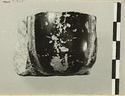
| Part of "egg" from krater of large dimensions, with egg and tongue band in relief.
Good black glaze, worn. Street of Marble Workers. Leica ... May 1964 |
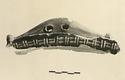
| Three fragments preserve handle, part of rim and wall. Small flat rim separated by two scraped grooves from body of vase. Flat lug handle, round at front edge and terminating at each end in a rotella; ... May 1947 |
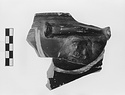
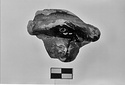
| Handle, bit of rim and wall preserved. Applique female(?) mask on wall underneath handle. Rim flat. Horizontal lug. Handle pierced vertically. Fully glazed.
Firm but dull black glaze. Cistern. Leica, ... 13-22 May 1969 |
| From a large bowl with lug handle attached below rim. The rim, decorated with two wide vertical and two yellow horizontal bars alternating, is flat on top and slightly projecting. Two holes pierced through ... 27 February 1953 |
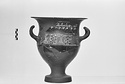
| Many fragments preserving much of rim, body, and part of both handles; nothing of foot preserved. Restored in plaster. Small bell krater with high, flaring rim, low rounded body, incurved round handles ... May 1947 |
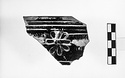
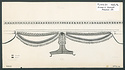
| Fragment from rim only. Vertical wall with flat horizontal rim projecting both inward and outward. Near top of wall on outside a garland of conventional rosettes and branches in thinned clay touched up ... 1932 |
| Around the cylindrical neck a thickened band as though to fasten the handle ends.
Dull black glaze over all; decorated with irregular dots and dashes in thin white and heavy clay-colored paint around ... 16 April 1932 |
| Mended from many fragments; all of the base missing, with parts of the wall and chips from the rim. Restored in plaster. Mended with lead clamps in antiquity.
Deep rounded bowl with flat-topped projecting ... 12-15 May 1939 |
Hellenistic fill, north of Temple of Ares, on either side of wall running east-west over 50/ΙΓ. Mostly coarse pottery including many stamped amphora handles.
Cf. also nb. P XII, pp. 2297-2298. Coins:
13 ... 275-200 B.C. |
A well behind the Stoa of Zeus. Noted as the finding place of the bronze head of Nike, B 30.
Two Rhodian stamped amphora handles. Fragments of only two bowls ... 260-210 B.C. |
Tiled well near the SW corner of the market square between the Southwest Fountain House and the Great Drain, three fills noted: lower fill of earth and stones with a few fragments only of coarse pottery ... 4th-2nd c. B.C.
100-70 B.C. |
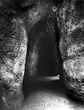
Cistern with two tunnels, the one entering its neck cut off by an early Roman well, the other, at the bottom not excavated.
Chamber conical in shape, with a depressed draw basin in the center of the floor ... Early Roman-3rd c. B.C. |
| Stucco-lined bottle-shaped cistern, with tunnel and subsidiary manhole, in SW Baths, Room Α 10. Homogeneous dumped fill, mostly of mold-made bowls and and molds for terracotta figurines. Sixteen stamped ... 225-190 B.C. |
| Komos Cistern at 66/Κ, on the north slope of the Areopagus. Homogeneous fill.
Thirty-four stamped amphora handles. Eight Histiaian tetrobols, dating 170-160 at the earliest, found near top, possibly an ... Last quarter of 3rd c. B.C.-Early 2nd century B.C. |
| Rotroff, S ... American School of Classical Studies at Athens ... The second of two volumes on the Hellenistic fine ware unearthed in excavations in the Athenian Agora, this book presents the Hellenistic wheelmade table ware and votive vessels found between 1931 and ... 1997 |
|
|