|
|
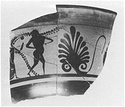
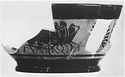
| Mended from eight pieces; part of the base ring and of one side with a piece of the rim preserved. Figured scene depicts two satyrs and a maenad. Sparing hasty incision for interior details; no accessory ... August-September 1932 |
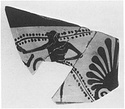
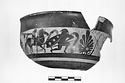
| Mended from six pieces; start of handle attachment at right of fragment. Figured scene depicts satyr and part of maenad. Rim as P 1359.
Sparing hasty incision for interior details; no accessory color; ... August-September 1932 |
| Mended from three pieces. None of lip preserved. To right of fragment a satyr, to the left part of another figure. Sparing hasty incision for interior details; no accessory color. Rectangular rockcut shaft ... August-September 1932 |
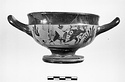
| Rim and walls fragmentary; handles missing. High ring foot and very wide open body with rounded rim. Beside the handles, palmettes dotted with white at the center; front and back, a four horse chariot, ... 2 June 1937 |
| About half the foot, less than half the walls, preserved. Base a high ring. Between palmettes, a quadriga, right, with a charioteer and a lyre player; an attendant beyond. Style and top-knots much as on ... 19-23 March 1936 |
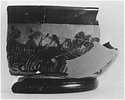
| Mended from many pieces. Only a fragment of rim and wall preserved and most of the base; no handles, but the start of one. Figured zone depicts quadriga right. The foreparts of the horses remain and part ... August-September 1932 |
| Figured zone depicts horseman and hoplite.
a) About half of body and rim preserved. Handles and foot missing. Beginning of handle indicated at right. Summary work. White used for panels on chiton and for ... August-September 1932 |
| Base and one side and part of the other preserved. Flaring ring base; out-turned lip.
A: Between palmettes among branches and fruits, a man seizes a lady around the legs. She is moving right, lifting ... 19-23 March 1936 |
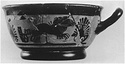
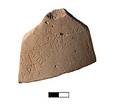
| A single fragment preserves part of the rim and wall, with one handle. Band skyphos with concave lip. Black glazed inside, save for reserved line at lip, outside on lip and lower wall, and on outside of ... 9 May 1939 |
Packing under cobblestones 7 or 8 meters west of the Temple of Hephaistos. A similar filling found in a small hole in bedrock three or four meters north of the Temple. The high quality of the pottery from ... Ca. 500-440 B.C. |
Well at 115/ΣΤ (all the 5th c. fills of 116/ΣΤ). The lower part of the shaft contained a heavy deposit of pottery and other objects of the late archaic period, both coarse and finer wares; probably a post-Persian ... Ca. 500-480 B.C.-Roman |
| This filling is the largest deposit of its time found in the Agora. It may be compared with H 6:5 and with N 7:3.
Dug in soft bedrock to a depth of 11.40m; footholds cut on opposite sides of the shaft ... Ca. 490-450 B.C. |
| A cave-in not long after the digging of this shaft destroyed its possible usefulness as a well and thereafter it was used as a dump. Two principle periods of such use were noted, and within these several ... Ca. 575-480 B.C. |
| Moore, M. B. Philippides, M. Z. P ... American School of Classical Studies at Athens ... This volume is the first of the Athenian Agora reports to deal specifically with figured wares; it is concerned with the black-figured pottery found in the excavations in the Athenian Agora between 1931 ... 1986 |
|
|