|
|
The pottery of the first six meters (containers 1-3 of 117 containers total) contains a good deal of unglazed early Byzantine along with very late Roman. Below this begins a great mass of Roman pottery ... 4th-6th c. A.D. POU |
A small square well at 37/ΚΑ (about 0.60x0.70m), on the north slope of the Areopagus. Curbed with rough stones.
Filling of a small shallow well which contained nothing from the POU and since no water was ... Ca. 350-320 B.C. |
Filling over bedrock. Coins:
26 May 1938 #7-#10
27 May 1938 #1
28 May 1938 #1 ... 1st-early 2nd c. A.D. |
Pit at 36/ΙΖ ... Late Hellenistic to Early Roman |
Coins:
19 May 1938 #1 (illegible)
20 May 1938 #3-#5, #12-#20 (Dump) ... 4th-6th c. A.D. |
| Cistern at 53/ΚΓ and channels. The pottery in the cistern and in the two channels was a thoroughly mixed lot of broken material from 5th c. B.C. to 4th c. A.D. and all seemed the same except the bottom ... 5th c. B.C.-4th c. A.D. |
Pit at 57/ΚΑ; small pit on the lower north slope of the Areopagus, measuring 1.05x0.80mx0.80m deep. There were traces of burning and a few bones in it, since none of them are recognizably human it is probably ... 480 - 470 B.C. |
Well at 55/ΚΕ
Period of Use dated to the last quarter of 5th c. B.C., Upper fill dated to the same (deposited later) in Agora XXX. Coins
1 April 1938 #10 ... Last quarter of 5th c. B.C. |
Well at 56/ΚΖ, just south of the south wall of the northern Late Roman Building ... Second half of 2nd c. - early 3rd c. A.D. |
| Roman Pithos at 38/ΛΔ. Cf. also Ψ734 (P 14037) from late pit at 41/ΛΓ ... Early to Middle Roman |
Deposit at 42/ΙΕ beside rubble wall under modern cellar wall ... 5th c. B.C. |
Manhole at 55/ΚΔ (Same system as O 19:2) ... 8 April 1938 |
Destruction debris in Late Roman Buildings on Lower N slope of Areopagus (see summaries under M-Q 17-21).
Over 130 coins came from this filling, of which some 51 survived in a condition to permit accurate ... 6th c. A.D. |
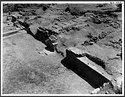
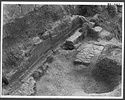
| Southeast corner of the Aiakeion after removal of the Hellenistic fill. Front foundation of the South Stoa II in lower left ... south 3424 Horizontal (normal) ... 29 Jul 1960 |
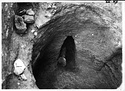
| West side of the building. Modern masonry supports remains of the aqueduct (marked "XX") ... northeast 3436 Horizontal (normal) ... 29 Jul 1960 |
| Poros Aqueduct at the southwest corner of the "Heliaia" (now identified as the Aiakeion). Foundation for south wall of the "Heliaia" in middle right ... southwest 3447 Horizontal (normal) ... 29 Jul 1960 |
| Late Roman Fortification Wall overlying the foundations of the Propylon. Arrows mark the corners of the Propylon. A) Fragment (I 4720m) from the Bouleutic list of 304/3; B) Dedicatory statue base, I 4850; ... I 4850 and I 4713 were found in section ΘΘ. (SD) east 227 Horizontal (normal) ... 6 Jun 1959 |
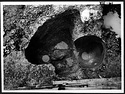
| Statue as found in south channel of cistern. Deposit O 19:2 ... 571 Horizontal (normal) ... 6 Apr 1938 |
| Statue as found in south channel of cistern. Deposit O 19:2 ... 572 Horizontal (normal) ... 6 Apr 1938 |
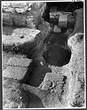
| Roman pithoi at 38/ΛΔ and 38/ΛΓ (Deposit O 19:6). Looking almost sraight down (south at the top) ... 350 Horizontal (normal) ... 7 Apr 1938 |
It may perhaps be assumed that in the 5th c. the Romans cleaned the well to 25.30m., thus removing 2nd c. and subsequent fill, and then began to reuse the shaft. Coins
20 May 1938 #6
21 May 1938 #1
25 ... POU 1st c. and 5th-6th c. A.D. |
Containers 1-52. Top to 20.00m. = modern fill.
Note a strong presence of W. Asia Minor (non-export-type) closed vessels here - did owner perhaps come from there? [JWH] Coins:
25 May 1938 #1-#2 ... Late Roman 5th-7th c. A.D. |
Containers 53 (transitional)-69. Coins:
20 May 1938 #6
21 May 1938 #1
26 May 1938 #1-#2 ... Early Roman 1st c. A.D. |
Well at 30/ΛΣΤ Coins (none useful)
25 May 1938 #3-#6
26 May 1938 #3-#4 ... Early 3rd cent and of 4th-6th cent. A.D. |
Tile well at 52/ΛΣΤ, in the northern late Roman building in the room with the apse. The top was covered by a large stone, and the well had never been filled after the last period of use. water stood to ... Late 1st (?) cent.-early 3rd to 6th cent. |
Well at 19/ΝΒ, on the lower north slope of the Areopagus ... 550-525 B.C. |
Well at 15/ΝΒ Coin
18 April 1938 #1 ... 18-20 April 1938 |
Stone-curbed well at NE corner of 18/ΞΓ ... 2nd c., at least as late as ca. 140 B.C. |
East (service) courtyard. A break ca. 540 was followed by an accumulation of nearly a meter of snail shells, and on top a small amount of pottery running down to the end of the 6th century. Coins(?): cf ... POU mid 3rd to late 6th c. |
Coins
20 May 1957 #1-#55
21 May 1957 #1-#79 P 26235 and P 26236 have nothing to do with the coins. Found in lower floor by pit ... Destroyed 267 A.D. |
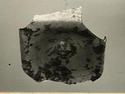
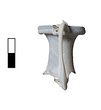
| Most of the bottom and part of the sides preserved.
Large square-bottomed bottle, the floor rising to a high sharp point inside.
Greenish glass. Catalogued 1959. Old grid: ca. 35/ΝΗ. There are storaged ... 13 May 1957 |
| Apparently intact.
Solid hub. Mixed fill. Store in ziplock polyethylene bag and in area with 40% r.h. or lower.
Wear cotton or latex gloves when handling. Leica ... 8 June 1938 |
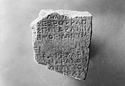
| Fragments of an inscribed stele.
Fragment Λ 59a (a), the left hand is preserved, and on the face the first letter in each of seven lines of the inscription, with traces of a second letter in the first ... Ca. 485 B.C. |
| Inscribed fragments.
List of names; "POLETAI" record.
Fragment Ζ 331 a), inscribed fragment.
Broken on all sides.
Nine lines of the inscription preserved, with a space between the fourth and fifth.
Fragment ... First half of 4th. century B.C. |
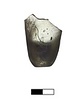
| Lower part of small almost cylindrical vase.
Base broken away.
Yellowish green opalescent glass. Latest Roman destruction debris, white fill.
6th c. A.D. Leica ... 21 April 1938 |
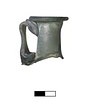
| Mouth with pine cone stopper.
The mouth, narrow neck, and most of the handle are preserved.
Handle two-ribbed.
Stuck in the mouth, point downward is a small pine cone, obviously used as a stopper. The ... 20 May 1938 |
| Most of mouth, neck and handle preserved.
Broad flat handle. Well. Lower fill. Container 38. Leica ... 23 May 1938 |
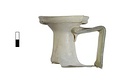
| Almost flat shoulder; narrow neck flaring out to upright grooved rim; broad angular handle.
Pale greenish glass. Well. Container 35. Leica PD 505 ... 15 June 1938 |
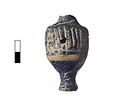
| Mended from several fragments; mouth and some of body missing.
Vertical ribbing on body. Small, high foot. Surface decorated with yellow lines.
Glass dark blue. Soft fill beside late Roman wall, outside ... 14 June 1938 |
|
|