|
|
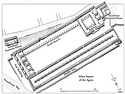
Material from trenches:
a) 1.00-7.00m. from East End of Stoa.
b) 18.40-21.40m. from East End of Stoa ... 1st c. A.D. |
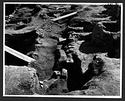
| South terrace: cutting for median wall of shop building at ca. 51/Λ. Cf. nb. p. 3303 ... east Horizontal (normal) ... 8 Mar 1953 |
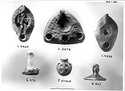
| Selection of three lamps (L 5469, L 5479, L 5453), a glass candlestick (G 576), an ampulla (P 27463) and a glass goblet fragment (G 567) illustrating the deposit over the floor of the rooms ... no deposit number (SD) ... September 1969 |
Well at 19/ΙΑ (corrected from O 13:2) Incised bowl
Graffito bowl
Water jug x2
Small amphora
Amphora x2
Canteen x2 Tins 132-138 (not found in notebook) ... 12th c. A.D. |
Destruction debris in L.R. water basin, 6th-7th c. A.D, set against back wall of South Stoa II ... 6th c. or 7th c. A.D. |
Rectangular cutting at 58-60/ΚΘ-Λ, probably a plundered wall trench ... 350-290 B.C. |
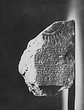
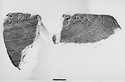
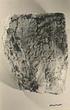
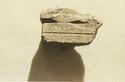
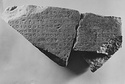
| Fragment Θ 26 a), from right side of inscribed block; fine picked on one side, rough picked on the back.
Fragment Κ 115 b), back and left side preserved. Fifteen lines of the inscription preserved.
Fragment ... 127/6 B.C. |
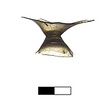
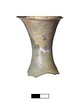
| Part of body and base preserved.
Made of two separate paraisons attached together.
Pale yellow glass, very delicate. Slight weathering. Late Roman Gymnasium, basement suite, room F, deposit on original ... August 1965 |
| Base preserved.
Conical, spreading at bottom. Round off, not folded.
Light blue glass, silver enamel weathering. Late Roman Gymnasium, basement suite, room F, deposit on original floor.
500-550 A.D. 2095, ... August 1965 |
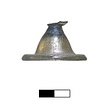
| Most of base and beginning of wall.
It has folded base, bulb above the base protruding into the cup.
Very delicate pale yellow glass, heavy enamel weathering. Late Roman Gymnasium, basement suite, room ... August 1965 |
| Rim and neck fragment.
Folded rim, narrow neck flaring below.
Pale green glass, very thick enamel weathering. Late Roman Gymnasium, basement suite, room F, deposit on original floor.
500-550 A.D. 2095, ... August 1965 |
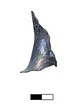
| From neck, broken all around.
Neck widens above and below.
Light blue. Late Roman Gymnasium, basement suite, room F, deposit on original floor.
500-550 A.D. 2095, 2259 Leica ... August 1965 |
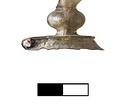
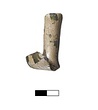
| Much missing from base.
Narrow holder spreading below to a cup-like base.
Light green glass, heavy weathering.
Cf. G 576, G 578. Late Roman Gymnasium, basement suite, room F, deposit on original floor ... August 1965 |
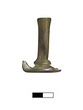
| Small fragment missing from lower section of holder. Much missing from cup, which is cracked.
Narrow holder spreading below, attached to a cup-like base.
Light green glass.
Cf. G 576, G 577. Late Roman ... August 1965 |
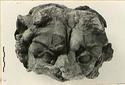
| Two joining fragments preserve a large lion's head spout which has the lower jaw, right ear and much of the nose missing. Traces of color in the eyes; a red pupil, surrounded by yellow; inside of the eyelids ... 4 August 1966 |
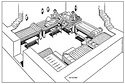
| Commercial, Civic Unknown Reused Material, Mudbrick Fair, foundations and walls up to a meter high ... 450-400 B.C. |
| Possibly Commercial Unknown Conglomerate, Limestone Fair, foundations and parts of stylobate and back wall ... Mid 2nd B.C. |
| Small fragment preserves part of original bottom, of one fascia and half of channel at each side.
From Square Peristyle.
Hard gray poros.
Cf. A 2209 (Τ 1808), triglyph of same material and workmanship ... 31 March 1953 |
| About one quarter of capital preserved with original top and bottom, and part of the rectangular cutting of the centering. Surface finished with at fine toothed chisel, as if intended for stucco but no ... 2 May 1953 |
| Mended from two pieces. Broken at top, right and back; cracked; front much battered.
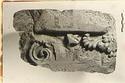
Floral decoration in relief; red background. Maeander painted in red on lower fascia. On back, near original left end ... 1953 |
| Broken all around. Left eye and part of forehead of lion's head spout. Orange brown clay. White on eyeball, red near center. Red paint of eyebrow, on which the hair is modeled.
Somewhat similar to A 2306 ... 14 May 1953 |
| Broken all around. Part of one glyph and full width of projecting fascia with edge of slot for metope. Hard poros with many holes.
From Square Peristyle.
Same series as A 1925 (Τ 1092), A 2239 (Τ 2026) ... 28 May 1953 |
| The iron clapper missing save few rust marks.
The ring at top worn thin from much use. below ca. 61.50m. Destruction debris north of east bay.
Late Roman fill, perhaps disturbed. Leica, Various vii-83 ... 10 June 1935 |
| The back is scooped out.
On the obverse, an owl, standing left, his head facing, crudely incised.
1/6 mina. It appears in the Illustrated London News, ILN (2 June 1934). Modern fill. Leica, 4-201, 4-214, ... 28 February 1934 |
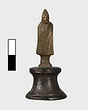
| A small standing figure wearing a pointed hood and a heavy knee-length cloak.
Attached to bronze base.
Noted:
Hesperia 19 (1950), p. 333, n. 36.
Hesperia 83 (2014), p. 167, n. 106.
Hesperia 90 (2021), ... 10 June 1936 |
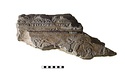
| Inscribed fragment.
The top and back preserved.
Above inscribed surface, a moulding.
Victor dedication.
Inscribed above and within two incised wreaths.
Hymettian marble.
ADDENDA Part of I 382. Finished ... 1st. century B.C. |
| Inscribed fragments.
Fragment Λ 102, top preserved; elsewhere broken.
Six lines of the inscription preserved, with two letters each, stoichedon, and traces of another line above.
Fragment Τ 1168, joining ... (Λ 102) 10 February 1934
(Τ 1168) 28 February 1952 |
| Inscribed fragment.
Broken at left and bottom; elsewhere much battered.
The upper right corner of a stele with crowning moulding; the side smooth, the top and back rough picked.
Preamble.
Parts of seven ... 179/8 B.C. |
| Fragments of a large base.
Honorary monument to council of the Areopagos.
Fragment Λ 106a (a), preserves the left side and part of the moulding above.
Five letters of the inscription and part of a sixth ... a) (Λ 106a) 10 February 1934
b) (Λ 106b) 10 February 1934
c) (Λ 106c) 24 February 1934
d) (Π 126) 13 February 1934 |
| Inscribed fragment.
Broken all round.
Parts of two letters preserved.
Pentelic marble.
ADDENDA With I 1228 (not joined)
This fragment is not contiguous, but it is probably that it belongs in line 4 of ... 3rd. century A.D. |
| Fragment from an inscribed Herm.
Broken at top, right side, back and bottom.
Part of the chest, and a strand of hair left preserved.
Part of eleven lines of the inscription preserved.
Pentelic marble ... Ca. 166/7 A.D. |
| Fragment inscribed in both Greek and Latin.
Left side perhaps preserved; elsewhere broken.
Part of four lines of the inscription preserved.
Pentelic marble. Found in the wall of the modern house 636α/14 ... Ca. 50 A.D. |
| Corner of inscribed block.
Funeral base.
Fragment Κ 14 a), top and left side preserved; broken away on the right, the back, and below.
Part of one line of the inscription preserved, with three letters ... Ca. 500 B.C. |
| Small inscribed fragment.
Broken on all sides.
Honorary monument to council of the Areopagos.
One letter preserved.
Pentelic marble.
ADDENDA Joined with I 781 and I 1166. Found in the wall of the modern ... 27 December 1933 |
| Small inscribed fragment.
Broken all round.
Honorary monument to council of the Areopagos.
Two letters, and part of a third, preserved.
Pentelic marble.
ADDENDA Joined with I 781 and I 1165. Found in ... 27 December 1933 |
| Fragments from an inscribed block.
Fragment Λ 36 a), the top smooth; other edges broken.
Part of five lines of the inscription preserved.
Fragment ΓΓ 49 b), part of two inscribed faces and the top preserved ... 5th. century B.C. |
| Inscribed fragment from a stele.
The back preserved, rough picked; the edges broken.
Parts of four lines of the inscription preserved.
Pentelic marble.
ADDENDA Joins with I 2607, which gives right side ... 30 December 1933 |
| Fragment of inscription.
Broken behind, on top and to the right.
Two flat fasciae; above, a cornice moulding continuing to the left side; at the left corner, the start of a raking cornice.
Inscribed on ... Late 2nd. or early 1st. centuries B.C. |
| Inscribed fragment.
Broken on all but two faces. These have what seem to be independent inscriptions, the longer of which is almost illegible.
Treasure record; for Athena and the other Gods.
The other ... Early 4th. century B.C. |
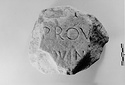
| Fragments of Latin inscription.
Fragments Λ 46 a and Κ 100 b), broken all round.
Part of three lines of the inscription preserved, on each fragment.
Fragment Λ 119 c), also broken all round; on it, part ... a) (Λ 46) 13 January 1934
b) (Κ 100) 22 February 1934
c) (Λ 119) 21 February 1934 |
|
|