|
|
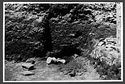
Water channel in scarp above Bouleuterion Plateia; north passage, from mouth ... Latest 2nd or early 1st c. B.C. |
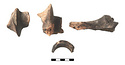
| Table support in the form of a statuette of Attis ... Horizontal (normal) ... 21 Apr 1933 |
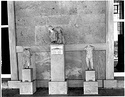
| Installation of the Hephaisteion sculptures, from the left, the Hesperides' group (S 429) Athena (S 1232) and a standing youth, possibly Herakles (S 1313) ... east ... 18 Sep 1958 |
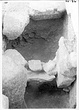
| Grave in south peristyle of Hephaisteion. Grave LXVII in notebook.
Crammed with bones (13 skulls): osteotheke. Coins:
13 March 1939 #26-#27 Neg. XV-86 ... 13-14 March 1939 |
Investigations to the south of the Metroon, in the passageway between the Metroon and the Tholos; accumulated layers, from the Geometric and earlier periods to the 3rd and 2nd centuries B.C.
Cf. Hesperia ... Geometric to second c. B.C. |
Investigations in the area around the Tholos, especially to the east and south of the building, between it and the Great Drain, and not otherwise specified as deposits.
This "deposit" has no form. It ... various levels and dates |
In front of room III from the South. Coins:
28 June 1933 #1
1 July 1933 #1
8 July 1933 #1 (dump)
12 July 1933 #1 (dump)-#2 (dump)
3 May 1934 #1
12 May 1934 #1 Estimated Grid ... Byzantine |
Also called Turkish well. Coins:
19 April 1933 #1-#4 ... 19 April-4 May 1933 |
A pit, perhaps a well, extending beneath the foundations of [Building D, the Primitive Bouleuterion] the Hellenistic Metroon. Not completely dug due to its position. A dumped filling so far as dug, apparently ... Ca. 575-525 B.C. |
Found while excavating Stoa Pit E in 1933. See also I 849 (Ε 329) found in the North Well in Stoa Pit E (Deposit H 9:1). Fragment Ε 496 of this inscription, listed with the finds of H 10:6, is likely from ... 8-10 May 1933
17 May 1935
18-26 May 1937 |
See also A 754 (Ε 501). Estimated Grid ... Roman |
No finds recorded. Estimated Grid ... Geometric |
Dug as Metroon Porch Pit A and Pit C (layers II and III). ... 7th-6th c. B.C. |
Dug as Tholos Trench V, Room E, burnt filling of plundered wall trench of S wall of court. See also lot Ζ 484 ... Late 6th c. B.C. |
Various layers and dates, primarily from Tholos Tr. L (area of early road drain), Q (area of road) and V (area of road).
Also Room G of Trench V listed with G-H 11-12 probably has road layers (no finds, ... 8th c.-ca. 480 B.C. |
Archaic house with Distyle Porch (= Building J) in southeast of section: packing beneath floors (Layers a and b of Tholos Trench S.Layer b=Beneath original floor dated to ca. 500 B.C.
Layer a=Between original ... 6th-early 5th c. B.C. |
| Grave LXVII (Deposit E 7:8). Grave lying against the cella wall, in the south peristyle by the seventh column. Cf. Hesperia Suppl. 5 (1941), p. 5, fig. 1 (Grave 20) ... if the skulls are packed at the west side we are looking west (SD) west 1881 ... 14 Mar 1939 |
Fills associated with construction of New Bouleuterion, i.e. inside porch, unused foundation trenches on west side and south side ... Down to last quarter of 5th c. B.C. |
Accumulated fillings in the Bouleutrion Plateia beginning in late 5th c. B.C. and continuing into the 3rd c. A.D., reaching a depth of 0.20-0.30m. (Hesp. 6 (1937), p. 168. Subdivisions:
.1=Layer I
.2=Layer ... 5th c. B.C.-3rd c. A.D. |
Accumulated filling over Bouleuterion Plateia, Layer II. Coins:
8 May 1935 #1 ... 1st or 2nd c. A.D. |
Coins:
8 May 1935 #2 ... 4th-2nd c. B.C. |
Also possibly object B 252 "scraping bedrock in south part; context too disturbed and uncertain to be trusted." ... 4th c. B.C. |
Well on Slopes of Kolonos, apparently with two periods of active service. The earlier dating from ca. the turn of the era well down into the 1st c. A.D. Probable that the well was never cleaned out in ... POU Early to second half 1st c. A.D. |
Exploration over bedrock inside the Tholos; levels of 6th c. B.C ... 6th c. B.C. |
| Roasting pits associated with the archaic buildings which preceded the Tholos ... Ca. 500-470 B.C. |
Well 8 (in Tholos), put out of use by a fall of the rock walls and replaced by well G 11:3. Scanty use filling at and near the bottom, separated by a mass of fallen rock from a debris filling in the upper ... Ca. 550-500 B.C. and 480 B.C. |
| Inscribed fragments.
Two fragments, which join, preserve the width and thickness of the stele; broken at top and bottom.
Tapering lightly toward the top. Sides smooth picked; back rough.
The upper part ... 155/4 B.C. |
| Fragment from upper right corner of inscribed base.
Broken away at back, bottom and left side. In the top, a circular sinking, for setting something.
Recessed 0.075m. from the inscribed band at the top ... 325/4 B.C. |
| Fragment from upper left corner of stele with pediment top.
The back rough picked.
Dedication of archonship Euandros.
Eight letters in one line, and one in the line above, preserved, beneath a taenia ... Late 3rd. century B.C. |
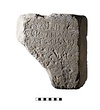
| Top of inscribed stele.
The full width of the stone, and the top surface, is preserved.
The plain top, on which are the first two lines of the inscription, projects 0.015m. from the main part of the stele ... 450 B.C. |
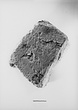
| Inscribed heptagonal base.
Bottom rough picked; top much worn and flaked, with a small round hole, near the inscribed face.
The circumference presents the deceptive appearance of what would have been an ... 1933 |
| Inscribed fragment.
Remains of an inscription in two columns, that to the right being a list of names. Parts of fifteen lines of the inscription preserved.
Pentelic marble. Pre-excavation. Found in the ... 1st. century B.C. (?). |
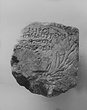
| Inscribed fragment from the right edge of the block, with part of the fine picked right surface preserved.
On the smooth finished face, the right side of a small wreath, open at the top, and the greater ... Middle of 1st. century B.C. |
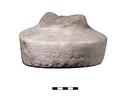
| Inscribed fragment of circular plinth
Emerging from the plinth is what appears to be a neck, broken off.
Pentelic marble. Found at a late Roman level, in front of the south end of the Metroon. 238 Leica, ... 4th. century B.C. (?). |
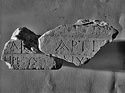
| Inscribed fragment with parts of two fascia.
Upper edge preserved; other sides broken; at the top, taenia, beveled back to fascia.
Inscribed with one line on each fascia.
Pentelic marble.
ADDENDA Joined ... 1st. century B.C. |
| Inscribed fragment with parts of two fascia.
Lower edge and surface preserved; other edges broken; the division between the fascia strongly marked by a groove.
Inscribed with one line on each fascia.
Pentelic ... 1st. century B.C. |
| Inscribed fragment.
Broken all round.
Fragment from the list of the Argives who fell at Tanagra.
Pentelic marble.
ADDENDA Joins with I 551, I 2006, I 3285, I 4893.
I 2006, g.v. for list of fragments, ... 5th. century B.C. |
|
|