|
|
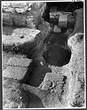
| Southeast corner of the Aiakeion after removal of the Hellenistic fill. Front foundation of the South Stoa II in lower left ... south 3424 Horizontal (normal) ... 29 Jul 1960 |
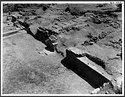
| West side of the building. Modern masonry supports remains of the aqueduct (marked "XX") ... northeast 3436 Horizontal (normal) ... 29 Jul 1960 |
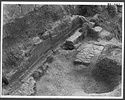
| Poros Aqueduct at the southwest corner of the "Heliaia" (now identified as the Aiakeion). Foundation for south wall of the "Heliaia" in middle right ... southwest 3447 Horizontal (normal) ... 29 Jul 1960 |
| Late Roman Fortification Wall overlying the foundations of the Propylon. Arrows mark the corners of the Propylon. A) Fragment (I 4720m) from the Bouleutic list of 304/3; B) Dedicatory statue base, I 4850; ... I 4850 and I 4713 were found in section ΘΘ. (SD) east 227 Horizontal (normal) ... 6 Jun 1959 |
Well P: EG ... Middle Geometric |
Tiled well (diam. 0.78m); height of tiles 0.61m. Water level -5m. Well found at bottom of Byzantine pit, uppermost tiles cut down. Coins:
7 July 1947 #1-#2 ... Post-Herulian |
| Rubbish Pit . Pit cut through a house floor. In courtyard, beside door to room 3. Artifacts, bone and scattering of large cinders in roughly rectangular pit dug through floor bedding and covered by red, ... 325-300 B.C. |
RSY Grave 49. Outside Archaic Cemetery ... 550-525 B.C. |
| Pyre in House C, Room 8 (RSY=Pyre 6).
Near east corner of room 8. Artifacts, burnt bone, burnt sticks, and large cinders in a shallow pit dug into surface of layer 3, and covered by layer 2. Some cinders ... 350-325 B.C.-end of 4th c. B.C. |
RSY Grave A.
Under the Roman House with three rooms floored with mosaic near the southwest side of the area. The burial consisted of a pot laid on its side over the bedrock, presumably containing a child ... 7 August 1947 |
Pit in House N, Room 2 (RSY, House C). Filling thrown in behind the west wall of the Great Drain South at the time of the building of the drain and the extension of House C.
Cf. Hesperia 20 (1951), pp ... Ca. 430-410 B.C. |
House N, Room 4, Pit through layers 5-6. Debris filling, mixed context. Estimated Grid ... Late 4th. c. B.C. into early 3rd c. B.C. |
Diameter 0.80m. Water level -2m. Tiled well; height of tiles 0.67m. well in court (Room 3) of House N.
Late Hellenistic destruction fill (Pergamene etc) to -7m;
Sand without a well deposit (lamp Type ... 1st c. B.C. to 1st c. A.D. |
A well (diameter 1m) in the industrial area west of the Areopagus, in the area later occupied by House C. Water level 1.50-2.m Dumped filling of broken bedrock with considerable fragmentary pottery in ... Ca. 500-480 B.C. |
Well (diameter shaft 0.95m) with POU and dumped fillings, separated by about 2.00m. of plain mud apparently fallen from the collapsed sides of the well. The fillings are, however, closely contemporary ... Ca. 425-400 B.C. |
Ca. 73-81/Drain. Fillings associated with the construction of the Great Drain South, especially the fill thrown in behind the east wall of the drain at the time of its building.
Cf. A 20-21:1 and B 19:7 ... Ca. 425-400 B.C. |
Dug bedrock filling in a well of unusually large diameter (1.35m.), possibly the original source of water for a factory for making terracotta figurines (water for the workshop with waterproofed floor and ... 4th. c. B.C. |
Deposit in the industrial area west of the Areopagus, underlying a Roman bath. Pottery examined in June 1955; latest pieces noted: one fragment Pergamene and one fragment brittle ware; no certainly post-Sullan ... Late 2nd c. B.C. |
Great Drain sand fill under Roman bath including small area at north end under tiles that was excavated separately.
See also A-B 19-20:1 for additional Great Drain sand fill at ca. 70-113/* Subdivisions: ... 30 July-11 August 1947 |
Coins:
30 July 1947 #3-#11
31 July 1947 #4-#19
1 August 1947 #1-#9
4 August 1947 #1-#20
5 August 1947 #3-#20
6 August 1947 #1-#38
7 August 1947 #1-#21
8 August 1947 #1-#41
9 August 1947 #3-#6
57-59/*
66-67/* ... 28-31 July 1947
6-9 August 1947 |
Great Drain South (ca. 70-113, from SW edge of section as far north as the Roman Bath) Hellenistic Sand Fill. Silted-up filling of the southern branch of the Great Drain, abandoned due to some damage at ... 4th. c.-86 B.C. |
Fillings to either side of the Great Drain, in the southern part of the area west of the Areopagus; various levels, late 6th. and early 5th c. B.C. to Sullan destruction. Coins:
26 July 1946 #1-#2
30 July ... Late 6th. c. B.C.-1st. c. A.D. |
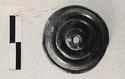
| Flat on one side, convex on the other.
The flat side is grooved, the convex side ribbed.
Round, with large hole through center. Rubbish pit.
4th c. B.C. 4348 Leica PD 2112-13 ... 26 April 1947 |
| Joins G 258.
No profile preserved.
Stuck all through with white bits (sea-shell ?) and blue rosettes with yellow centers.
Brownish-greenish glass, thin fabric. Great Drain in the area west of the Areopagus ... 31 May 1939 |
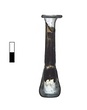
| Chips missing from bottom and from lip.
Small body with flat bottom; tall tapering neck and flaring round rim.
Greenish blue glass. Area west of Areopagus. Middle Roman brown fill. 3936 Leica, XXXIII-23 ... 2 April 1947 |
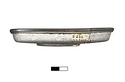
| About half the rim and wall preserved; the profile complete to the foot.
Flat bottom; bending up to a low straight side wall; small rounded lip made by turning the glass back on itself. Gravelly Roman ... 3 April 1947 |
| Joins G 212.
Rim fragment of a moulded bowl with plain rim.
Made with strips of brown, buff, yellow, blue and white glass inlaid to form a flower pattern; blue flowers with yellow centers against a brown ... 4 April 1947 |
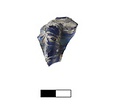
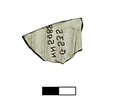
| From the wall of a moulded bowl, ribbed outside.
Blue and white striations. Brown fill. Early Roman level over Roman drain in area west of Areopagus. 4555 Leica ... 16 May 1947 |
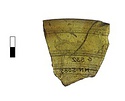
| Rim fragment.
Grooved inside.
Iridescent brown glaze. Molded glass. For context see Hesp. 20 (1951), pp. 279 ff. Excavation Date: (1955). Compartment under hypocaust room of east bath.
Late 2nd c. B.C ... 1955 |
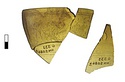
| Rim and wall fragments.
Grooves on rim and lower walls.
Brown iridescent molded glass. For context see Hesp. 20 (1951), pp. 279 ff. Excavation Date: (1955). Compartment under hypocaust room of east bath ... 1955 |
| Rim fragment.
Grooves below rim on the inside.
Brown molded glass. For context see Hesp. 20 (1951), pp. 279 ff. Excavation Date: (1955). Compartment under hypocaust room of east bath.
Late 2nd c. B.C ... 1955 |
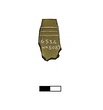
| Wall fragment.
Grooved on inside.
Green molded glass. For context see Hesp. 20 (1951), pp. 279 ff. Excavation Date: (1955). Compartment under hypocaust room of east bath.
Late 2nd c. B.C. 7951 Leica ... 1955 |
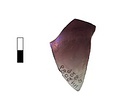
| Wall fragment.
Purple iridescent molded glass. For context see Hesp. 20 (1951), pp. 279 ff. Excavation Date: (1955). Compartment under hypocaust room of east bath.
Late 2nd c. B.C. 7951 Leica ... 1955 |
| Mended from many pieces.
Grooved below rim on the inside.
Brown iridescent molded glass; white incrustation. For context see Hesp. 20 (1951), pp. 279 ff. Excavation Date: (1955). Compartment under hypocaust ... 1955 |
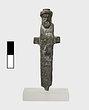
| Complete.
Bearded head with low polos-like cap.
Herm ends below in a spike.
Cf. Hesperia 90 (2021), p. 399, n. 112. Μικροσκοπική χάλκινη Ερμαϊκή στήλη. Σχεδόν ακέραια. Great Drain, sand fill; dump. Stoa ... 12 August 1947 |
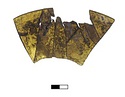
| Broken into five pieces and very fragmentary.
Inscribed. From the "dump". Store in ziplock polyethylene bag and in area with 40% r.h. or lower.
Wear cotton or latex gloves when handling. Do not bang around ... 25 October 1947 |
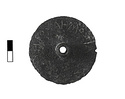
| Wheel ballot with pierced hub.
Inscribed around edge. On the opposite face, a small roughly rectangular stamp, containing a letter in relief ? Λ or N ? 76-79/Great Drain.
In loan to Barcelona (Museum Caixa ... 9 May 1947 |
| Small rectangular block of bronze, almost square.
Inscribed on the upper face with the symbols of three drachmas (?)
(After cleanning this would seem to be four drachmas). 76-79/Great Drain Great Drain, ... 9 May 1947 |
|
|