|
|
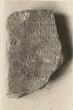
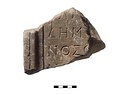
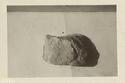
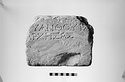
| A: letters enclosed in wreath.
B: plain.
Small hole pierced through token at lower right, later.
Cf. JIAN (1900), no. 118, name of deme enclosed in wreath. Entered as coin no. 10, for the day. Surface ... 11 February 1933 |
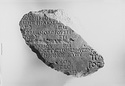
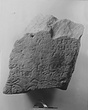
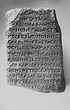
| Inscribed fragment.
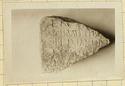
Left edge and part of rough picked back surface preserved. Other edges broken.
The left end of thirteen lines preserved.
Hymettian marble.
ADDENDA Joins with I 3240. Found in a modern ... Late 2nd. or 3rd. centuries A.D. |
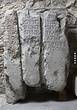
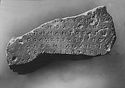
| Inscribed fragment.
Edges broken; back rough picked and worn smooth as if from later use.
Epitaph of Benjamin Gott.
White marble.
ADDENDA Goes with I 1111, EM 5436. Found in a probably modern level, in ... 1817 |
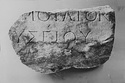
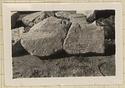
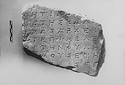
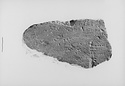
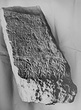
| Fragment of inscribed stele.
Broken all around and at the back.
Parts of twelve lines of the inscription preserved. An erasure between lines six and seven.
Pentelic marble. Found in modern foundation, ... Ca. 100 A.D. |
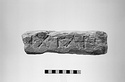
| Fragment from bottom part of inscribed stele.
Pentelic marble. Found in modern foundation, in the southeastern part of the Market Square. Leica ... 20 February 1933 |
| Fragment from right side of inscribed block.
The right side is picked fine; the face dressed smooth, other edges broken.
Dedication mentions the Museum, the Univeristy of Athens.
Parts of two lines of ... Early 3rd. century A.D. |
| Fragment of inscribed stele.
Part of smooth picked top and rough back preserved.
Other edges broken. Above the inscription a horizontal groove.
Remains of six lines of the inscription.
Pentelic marble ... Ca. 210 A.D. |
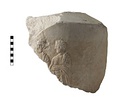
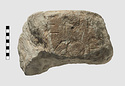
| Part of the shoulder and wall preserved, with part of two draped bearded figures in low relief.
The figure to the left (head and shoulder only) faces forward, the one to the right, preserved to below ... 10 February 1933 |
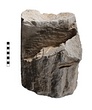
| Bottom, back and left side of block preserved. The front part of the plinth and the foot behind the instep are broken.
The relief surface is partly smooth, partly picked. The thongs of the sandal are in ... 16 February 1933 |
| Broken off above the waist.
The figure wears a thin chiton with overhang and has an himation across the knees. She is seated, with the left foot advanced, upon a cushioned seat, which is hollowed out at ... 28 February 1933 |
| Typical shape.
Typical clay.
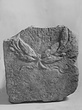
Impression incomplete above and below, espercially to left; left end broken away.
This combination is given in Dumont with trident and several other marine attributes. The ... 16 February 1933 |
| Top part of small columnar grave monument.
About half the top above the ring is broken away.
Inscribed in three lines.
Hymettian marble. Found in a modern wall, over the eastern part of the Temple of Ares ... 28 February 1933 |
| Inscribed fragment of grave stele.
The right side preserved with a raised band, other edges broken.
Inscribed along the bottom of a plain, smooth surface.
Eleven letters preserved.
Pentelic marble.
ADDENDA ... 27 February 1933 |
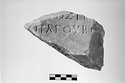
| Fragment of inscribed stone.
Top is preserved, and at left, two sides of rectangular cutting, 0.105m. from inscribed face.
The angle between the top and the inscribed surface is mostly worn away.
One line ... 27 February 1933 |
| Inscribed fragment.
Broken all around and at the back.
There is a curious strip across the back which has been worn or worked smooth.
Traces of five letters remain.
Pentelic marble. Found in modern foundation, ... 27 February 1933 |
| Lower part of inscribed stele with wreath in relief.
Sides chiselled; back and bottom rough picked.
All dimensions except height preserved. Right back corner broken.
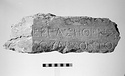
Dedication to Hadrian Saviour and Founder ... 28 February 1933 |
| Inscribed fragment.
Broken all sides, and back.
Surface dressed fine.
Parts of two lines of the inscription preserved.
Pentelic marble. Found in loose fill bellow cellar floor, in late Roman context, southeast ... 1 March 1933 |
| Fragment of inscribed stele.
Broken all round.
Parts of six lines of the inscription preserved, arranged in columns.
Upper part of two wreaths preserved below lines.
Pentelic marble.
Cf. I 138. Belongs ... Ca. 128 B.C. |
| Three fragments of an inscribed statue base. Top rough picked.
The fragments join (in the order c, a, b), but the stone has been split in three pieces, so that one or more letters are missing in each line ... 1st. century A.D. |
| Large fragment from inscribed base.
Right side preserved; other edges broken.
On the inscribed face, the right end of three lines of the inscription preserved.
Pentelic marble.
ADDENDA Joins with I 719; ... 325 B.C. |
| Inscribed fragment.
Part of the right side, much worn, is preseved; other edges broken.
Six letters remain.
Grayish marble. Found in the modern wall of the house 646/5, over the area of the Library of ... 3 February 1933 |
| Fragment of stele inscribed on both sides.
Broken top, bottom and both sides.
Letter of Hadrian.
Fourteen lines of the inscription preserved on face A, ten on face B.
Lines and letters more widely spaced ... 117-138 A.D. |
| Inscribed fragment; moulding along left edge.
The left side, finished smooth, preserved; other edges broken.
The start of four lines of the inscription preserved.
White marble. Found in the modern wall ... 6 February 1933 |
| Inscribed statue base.
Finished on three sides with mouldings top and bottom, each overhangs ca. 0.07m.
On the top, rather more than half way back, are two dowel holes, one of which still shows the pour ... 6 February 1933 |
| Fragment from left side of stele.
Tribal decree honoring a thesmothetes.
Parts of nine lines of the inscription preserved; stoichedon.
Blue and white-veined marble. Found in a modern wall, south of the ... Ca. 325 B.C. |
| Fragment of inscribed stele.
Rough picked behind; the edges broken.
Parts of thirteen lines preserved, stoichedon; fifteen letters to 0.20m.
Fragment mentioning trieropoioi.
Pentelic marble.
Transferred ... 5th. century B.C. |
| Fragment from an inscribed stele.
Broken all round.
Parts of eight lines of the inscription preserved.
Hymettian marble.
ADDENDA I 929, I 990, I 2259, I 2301 and I 7479 belong and join with each other ... Mid 3rd. century B.C. |
| Fragment from an inscribed stele.
Edges broken; back, rough picked, preserved, worked smooth to within ca. 0.10m. of the present bottom of the stone, where a boss-like mass, rough picked, projects.
Seventeen ... Late 3rd. or early 2nd. centuries B.C. |
| Two fragments of inscribed block.
Dedication to Emperor Geta.
Fragment a) (Ι 70), part of left edge preserved; others broken.
Part of three lines of the inscription preserved.
Fragment b) (Ι 70), two ... 209-212 A.D. |
| Small inscribed fragment.
Broken all round.
Dedication to Emperor Geta.
Parts of two lines of the inscription, two letters in each, preserved.
Hymettian marble.
ADDENDA Part of the same inscription as ... 9 February 1933 |
| Fragment from an inscribed base (?).
Broken all round; the rough picked top appears not to be original.
Dedication.
Parts of two lines of the inscription preserved.
Hymettian marble. Found in the wall ... 10 February 1933 |
| Fragment from right hand side of inscribed stele.
Right edge rough dressed.
Dedication by the Athenians who lived in Myrina.
Parts of two lines of the inscription preserved; below the second line is something ... After 166 B.C. |
| Inscribed fragment.
From upper right corner (?); back, bottom and left side broken; above, the top recedes at an oblique angle as a smooth, rasped surface, probably reworked.
Parts of two lines of the ... 14 February 1933 |
| Lower left corner of inscribed block.
Surface badly weathered.
List of names; possibly from a list of Prytanies.
Parts of two lines of the inscription preserved.
Pentelic marble. Found in a modern wall, ... 2nd. century B.C. |
| Inscribed fragment.
Broken at back, bottom and sides; the top surface probably preserved, but much flaked.
Carefully finished face, inscribed in two lines.
Hymettian marble. Found at a modern level, southwest ... 25 February 1933 |
| Inscribed fragment.
Rough picked top preserved; other edges broken.
Choregic dedication.
Parts of two lines of the inscription preserved, with six letters.
Pentelic marble. Finished Found probably at a ... 16 February 1933 |
| Inscribed fragment.
Broken all round; the front worn.
Parts of three lines of the inscription preserved.
Hymettian marble. Found in a modern wall, north of the western part of the Middle Stoa. Leica, 84-417 ... Early 4th. century B.C. |
| Fragment of inscribed base.
Broken at both sides and back.
Dedication made by a trierarch or gymnasiarch.
Parts of two lines of the inscription preserved.
Hymettian marble. Found in modern foundation, ... 23 February 1933 |
| Inscribed fragment.
Left side rough picked, and back smooth preserved. Other edges broken.
Remains of six lines of the inscription.
Pentelic marble. Found in late Roman to Byzantine context, south of the ... 2nd. century A.D. |
| Lower right corner of large inscribed stele.
Part of the bottom, picked fine, preserved, and of the right side with a heavy base moulding which, on the face, has been hacked away. Other edges broken.
On ... Mid 1st. century B.C. |
|
|