|
|
Miṣr ... Abd ül-Ḥamīd I ... Coin no. 1. GCM 882.1. N.W. corner of section, above gravel road. 1052 ... 1774-1789 A.D. |
Miṣr ... Abd ül-Ḥamīd I ... Coin no. 2. GCM 882.2. N.W. corner of section, above gravel road. 1052 ... 1774-1789 A.D. |
Uncertain Islamic ... "Local coinage of the second half of the 15th c. (?) ... Coins with unsystematic designs or markings ... Very few show characteristics that might be interpreted as imitations of Turkish legends. Mostly ... 26 January 1934 |
Uncertain Sultan ... "Ribbon fabric." Coin no. 3. GCM 883.3. West of westernmost wall of Byzantine Building, from gravelly layer at level of top of that wall. 1053, 1055 ... 15th-16th c. A.D. |
Uncertain Sultan ... "Ribbon fabric." Coin no. 1. GCM 884.1. Byzantine Building, Room XVIII, from level of its wall top to bottom of first course of blocks. 1100, 1142, 1593 ... 15th-16th c. A.D. |
Uncertain Sultan ... "Ribbon fabric." Coin no. 2. GCM 884.2. Byzantine Building, Room XVIII, from level of its wall top to bottom of first course of blocks. 1100, 1142, 1593 ... 15th-16th c. A.D. |
Uncertain Sultan ... Coin no. 1. GCM 885.1. Trial pit for continuation of "Royal Stoa" in Poseidon Street. 1355, 1379 ... 16th c. A.D. |
Athens ... Fragmentary.
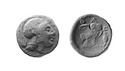
Unclassified. Coin no. 7. Byzantine building, room XXV, lying on floor. Head or bust of Athena r. Border of dots. ΑΘ-Η-Ν-ΑΙΩΝ (obscure) Triptolemos standing l. in chariot drawn by two snakes ... Ca. 264-267 A.D. |
| Athens ... Overstrike. Coin no. 3.
Casts stored in Lab Case 52D Byzantine building, room XXIV, loose filling below floor 2. Head of Athena r., wearing Attic helmet. Θ/Α/Ε
Owl standing three-quarters r., facing, wings ... ca. 224/3--198 B.C. |
Corinth ... Marcus Aurelius. Coin no. 15. Byzantine building, room XXI, below floor 3. [M AVR] ANTO[NINVS AVG] Head r., laureate. [CLI COR]
Melikertes on dolphin r., under pine tree. 1140, 1143, 1145, 1598 ... 161-180 A.D. |
| Antioch on the Orontes ... Time of Volusian. Coin no. 10.
Casts stored in Lab Case 52D Byzantine building, dump. [- - - - - - - -]
Bust of Volusian r., radiate. ΔΗΜΑΡΧ-ΞΟVCΙΑC
Eagle, standing, facing, head l., wreath in beak; in ... 252-254 A.D. |
Phlious ... Broken.
Originally identified as Athens, Svoronos (1923), pl. 22:35-40. Coin no. 6. Byzantine building, room XX, between floors 2 and 3. Bull butting l. Φ framed by four globules. 1303, 1306, 1596 ... 4th century B.C. |
Athens ... Coin no. 4. Byzantine building, room XVIII, lowest black fill above classical floor. 1423 ... 8 May 1934 |
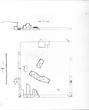
| Plan of the Sanctuary of the Twelve Gods ... PD 124 C.S. S ... 1934 |
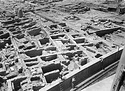
| Byzantine building: note the southwest corner of the Peribolos of the Twelve Gods behind the railroad retaining wall, at the first ladder from the left ... southwest Horizontal (normal) ... 12 May 1934 |
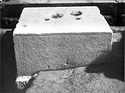
| Statue base with a dedication by Leagros ... 1934 |
| Altar of the Twelve Gods and the Leagros base. Southwest corner of the sanctuary during excavations ... east ... 21 Mar 1934 |
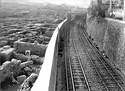
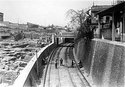
| Survey pits in the railroad cut in order to find the other corners of the Altar of the Twelve Gods. Cf. Hesperia 4 (1935), p. 357 ... west ... 5 Apr 1934 |
| Survey pits in the railroad cut in order to find the other corners of the Altar of the Twelve Gods. Cf. Hesperia 4 (1935), p. 357 ... west Horizontal (normal) ... 14 Apr 1934 |
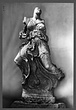
| Akroterion from the Stoa of Zeus. Winged female figure, flying, wearing double-girt chiton. Life size Nike with fragment of head attached. Pentelic marble. Front view ... Horizontal (normal) ... 1934 |
| Mixed ... H. Α. Thompson ... 983 1180 ... 1933, 1934 |
| Mixed ... H.Α. Thompson ... 1181 1373 ... 1934 |
| Mixed ... H.Α. Thompson ... 1374 1563 ... 1934, 1936, 1938 |
| Upper, right hand front corner remains, preserving width of one glyph and cutting for headband of metope.
From the Stoa of Zeus.
Granular Aeginetan poros, retaining traces of the paint. Clearing east foundation ... 1934 |
| Broken at right end, behind and below. Finished with toothed chisel on left end and top.
An ovolo surmounted by a plain fascia.
Fair work.
Pentelic marble. Found in the front of the S.E. corner of the ... 12 May 1934 |
| Granular Poros stone.
Found at H/18-7/14 (Fall 2016). Found built into the substructure of the eastward extension of the small 'rectangular building' to the north of the Apollo temple. From the earth ... 1934 |
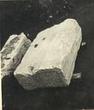
| Bottom step block. All surfaces preserved with anathyrosis on both ends. Top surface smooth with setting line 0.395m. from front surface.
For a distance of 0.330m. from front surface we have a raised area ... 23 January 1934 |
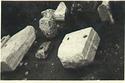
| Bottom step block. Both ends broken.
Front surface worked smooth to 0.120m. from top. The remaining surface below projects 0.01m. from this finished face and is rough-picked.
Top surface badly weathered ... 23 January 1934 |
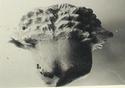
| Lower jaw and muzzle broken away and the whole head torn from the sima. Hair of crown schematically rendered by pyramidal tufts placed on checkerboard arrangement.
Assigned to either the Temple of Ares ... 5 February 1934 |
| Flat profile.
Coarse micaceous clay, fired buff inside with a pale yellow wash outside; distinct,
rather thick slip.
Retrograde.
Thasian(?). Stored wit "άγνωστα".
Class: Th?*
Dim: W 0.044* Byzantine ... 12 May 1934 |
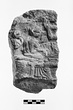
| The tenon for setting and the mid-part of the plaque remain. A draped figure is seated on a stool, facing right. Behind him stands a boy, resting his left hand on the handle of a large krater that stands ... 1 May 1934 |
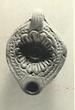
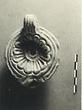
| Rosette on discus; herringbone on rim.
Solid handle, triple grooved above, double below.
On the bottom, two concentric grooves.
Type XXVIII of Corinth collection. Byzantine Building, Room xxvii, west ... 10 February 1934 |
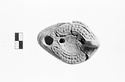
| Mended from several pieces; bits missing.
Cross on discus; impressed circles on rim. Pointed knob handle. Flat bottom with two almond-shaped grooves enclosing several stamped circles.
Crumbly red clay ... 10 February 1934 |
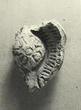
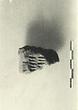
| Part of one side of the mold for the upper part of the lamp.
On the discus, a rosette; on the slanting rim two rows of short parallel lines.
Channel from discus to wick hole.
Coarse red clay.
For lamp ... 12 February 1934 |
| About half the base and a bit of the side wall preserved, with the signature inside a single groove.
Type XVIII of Corinth collection.
Byzantine Building, room xxvii, below floor 5. Cf. coin, ii. 12.34, ... 12 February 1934 |
| Nozzle and handle broken away.
Rosette on discus; on the rim, debased grape leaves and tendrils.
Reverse, plain.
Type XXVIII of Corinth collection. Byzantine Building, room xxvii, below floor 4. Cf. coin, ... 12 February 1934 |
| Mended from several pieces.
On the discus a bird, in a relief. Double row of raised dots on the rim. Solid handle.
On the bottom, two almond-shaped grooves with four circles between the grooves, and a ... 12 February 1934 |
| Nozzle broken away.
On discus, rosette; on rim, two grooves; handle solid, three grooves above, two below.
On reverse, within two almond-shaped lines a "C".
Thin red glaze.
Red clay.
Type XXVIII of Corinth ... 13 February 1934 |
| In channel of rim a band of circles with two diameters drawn in each, and with a tiny circle in each quadrant.
On discus, Christ erect holding cross in right hand; a winged angel flies toward him from ... 10 February 1934 |
| Fragment from edge of upper mould.
The rim was to be decorated with two rows of short parallel bars.
Coarse red clay.
Mold for late Roman lamps. Dump. Leica ... 22 February 1934 |
|
|