|
|
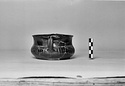
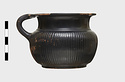
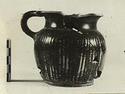
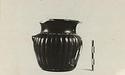
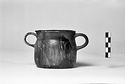
| Two-handled mug. One handle, much of floor and wall missing; restored in plaster. Low base ring; shallow reeding; plain beading at root of neck; double handles.
Firm black glaze scratched away from grooves ... 24 February 1935 |
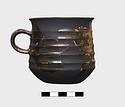
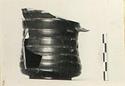
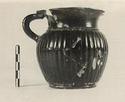
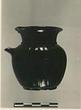
| Base missing and much of wall. Restored in plaster. Slightly flaring lip; single, vertical strap handle. Horizontal ribbing on wall.
Flaky black glaze.
(For fragments of another similar(?) with narrower ... 28 February 1935 |
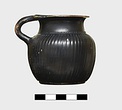
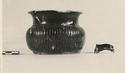
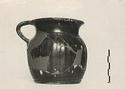
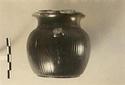
| Part of double handles restored. Mended from many fragments. Practically complete. Wide mouth. Light vertical ribbing on sides. Rope pattern on neck. Shallow moulded base edged by black band inside reserved ... 4 April 1933 |
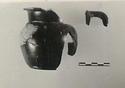
| Much of the edge of the lip is chipped. In shape and decoration like P 2339.
Fine glaze.
Oinochoe type 8.
ADDENDA P 2339: Wide mouth. Light vertical ribbing on sides. Rope pattern on neck. Shallow ... 4 April 1933 |
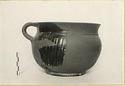
| Mended from many pieces. Almost all of rim, and many pieces of the side are missing. Two zones of "petal" pattern flanking tongue around sides. Rope pattern at base of neck.
Fine black glaze over the ... 4 April 1933 |
| [Originally identified as kantharos]
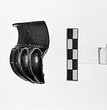
Two joining fragments from wall.
Three horizontal lines, above and below with groups of three concentric semicircles.
Very good glaze inside and out. Stoa Terrace, ... 1 December 1953 |
| Mended from many fragments. Full profile preserved; handle and much of upper half missing; restored in plaster. Large ribbed mug with double handle of which upper attachment preserved. Rope-like moulding ... 11 May 1953 |
| Chips missing from rim. Low ring foot; double handle with shouldering. Nicked ridge at base of neck. Neat reeding, narrow and close-set, on wall.
Good glaze overall. Μελαμβαφές κύπελλο, με ραβδωτή διακόσμηση ... 17 April 1954 |
| Mended from several pieces; lower attachment of vertical band handle preserved. Three non-joining fragments appear to come from the plain high flaring rim. Very low ring foot with narrow concave offset ... 19 April 1954 |
| Three joining fragments preserve part of rim and wall. Petal ribbing on wall. Concentric circles near base of rim and in bottom of petals.
Glaze discolored to a mottled brown.
Sherds from same fill stored ... April 1952 |
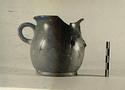
| Mended from many fragments; complete except for chips and most of double rolled vertical handle. Ring foot; round body with projecting bumps many of whose tips have broken off, leaving holes; straight ... 20 July 1946 |
| Part of wall, lip and one handle missing. Restored in plaster. Low ring base. Low plump body drawn in only very slightly toward the base. At the top, the wall draws slightly inward, and then flares out ... 21 May 1940 |
| Three joining fragments preserve part of lip and wall to just above foot. Body vertically ribbed; flaring lip separated from shoulder by raised moulding, cabled.
Good black glaze; reserved groove just ... 17-24 May 1940 |
| Much mended; small fragments missing. Very low ring foot, shallow grooved body, flaring rim and double rolled handle with shouldering. Nicked ridge at junction of neck and shoulder; stamped eggs and reversed ... September 1947 |
| Mended from two pieces. Two-thirds of the walls including most of one handle and all of the second(?) missing. Restored in plaster. Nearly vertical high rim set off by a ridge; low ring foot; vertical ... 6 June 1951 |
| Mended from many fragments; bits of rim and body missing. Out-turned lip. Double vertical handle with "shouldering'. Vertical ribbing on body; nicked ridge at base of neck. Flat bottom, set off by a groove ... 8 May 1939 |
| Mended from many pieces; much of wall and rim missing. Non-joining fragment of handle. Low ring foot; rounded wall, reeded, with a row of stamped ovules at its base. Nicked ridge at base of neck; out-turned ... 8 May 1939 |
| Profile complete; wall fragmentary; handle fragment does not join. Flat bottom set off by groove around lower wall; plain rounded wall; out-turned lip, double rolled handle.
Rather dull black glaze, ... 8 May 1939 |
| Part of bottom and side wall preserved; ring foot, set off from wall outside by a groove. On side, close to bottom, stamped lotus flowers connected each to each by heavy down-curving loops.
Incised on ... 2 May 1939 |
| Intact except for handle. Ring foot, set off from the wall by a groove; shoulder gently rounded. A nicked ridge at junction of shoulder and neck. Round mouth with out-turned lip. Double rolled handle with ... 26 May 1939 |
| The handle broken off, and the adjacent part of the rim; otherwise intact. Low ring foot; rim rather broad, sharply out-turned, flat on top. Broad ribbing; nicked ridge at junction with neck.
Blue-black ... 26 July 1947 |
| Three joining fragments give part of neck and wall with trace of handle attachment. Nicked band at base of neck; broad grooved X's and verticals on shoulder; then a band of stamped eggs; and below, inverted ... October 1947 |
| Missing a few fragments from body and one from rim. Restored in plaster. Flat bottom, concave at center. Outside, at the base, a narrow groove between flat ridges. Lightly ribbed walls. Low notched ridge ... May-June 1951 |
| Mended from several pieces. About two-thirds of the lip missing, also small pieces of the walls, and the handle all but the lower attachment. Very low ring foot; wall petal-ribbed all around; nicked ridge ... 7 July 1947 |
| Fragments of body and rim missing. Low ring foot, one reserved and two glazed grooves above it. Body ribbed; raised band, cabled, at its junction with flaring rim. One double rolled handle, shoulder to ... 26 September 1947 |
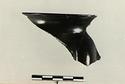
| Three joining fragments make up section of wall and bit of low ring foot; wall slightly concave. Sharp horizontal ribbing.
Resting surface reserved. Glaze fired dark gray to red. Rectangular pit. 1210 ... 25 April 1957 |
| Fragment from rim and wall. Very broad petal ribbing on the wall.
Excellent blue-black glaze. Rectangular pit. 1210 Leica ... 25 April 1957 |
| High out-turned rim, ridge at junction with body. Squat body; lightly moulded ridge near foot. Double handle. Scraped grooves: one on wall below moulded ridge; another at join of body and foot, a third ... (1955) |
| None of the rim or handle preserved. Walls restored in plaster. The wall is ornamented by vertical grooves in groups of three, and by stamped eggs and palmettes. At the bottom of each set of grooves are ... 21 March-16 April 1935 |
| From the lower part of a squat jug (oinochoe, Type VIII), ribbed, with a fine palmette at the base of each rib. Foot nicked; neatly rounded. Black beneath. See P 8067 (ΚΚ 867). Strosis 1-5, 1st. c. B.C ... 22 February 1936 |
| About half of rim and walls, one handle and trace of attachment of the other preserved. Restored in plaster. Nearly vertical walls; slightly out-turned rim; vertical band handles. Light grooves around ... March 1937 |
| Fragments of rim and wall missing. Finely moulded ring foot, deep body and narrow flaring lip. Grooved ring handles set just below lip. A scraped groove just above the foot. The underside reserved, with ... 27 May 1937 |
| Mended from many pieces. Part of wall, handle, base, missing; restored in plaster. Very low foot ring, sharply set off from wall; squat body; low neck with flaring lip; vertical double handle. Body with ... 15-26 May 1936 |
| Fragment only, preserving part of low, convex wall, high concave neck and attachment for a broad vertical handle. Neck is sharply set off from wall by an angular groove. Wall decorated with a geometric ... 15-26 May 1936 |
| Small oinochoe, shape 8. Double handle split at the rim attachment, missing. Squat body with low ring foot and concave flaring lip. On body, vertical grooves; around base of lip, moulded cable. Under handle, ... 2 April 1936 |
| About half of wall and lip, with handle, missing; restored in plaster. Broad low ring foot; squat body with convex outline; neck slightly drawn in; wide mouth; plain everted lip. At base of neck a ridge ... 2-19 May 1939 |
Part of neck and wall.
The pattern on the wall consists of, at the top, vertically scored lines with crosses between, then two grooves, ovules, two grooves from which hang palmettes between diagonally ... 450-425 B.C. |
Two fragments preserve most of foot and wall with lower handle-root.
Ring foot, with scraped groove at center of underside. Plain wall, with two grooves on lowest part. Ridge at junction of neck and wall ... Ca. 420 B.C. |
Handle missing.
Ring foot. Scraped groove round lowest part of wall. Double handle with shouldering. Reserved: resting surface and underside with glazed circle and central dot. Large ... Ca. 430 B.C. |
Ring foot with concave moulding on inner face. Ridge and raised ring on underside. Bubble-like protruberances on the wall. Two grooves on lowest part of wall. Double handle with shouldering.
Other fragments ... 425-400 B.C. |
|
|