|
|
Elongated one-piece shape; exaggerated trefoil rim with moderate spur at handle-attachment inside. Gritty micaceous pinkish clay; buff surfaces; mastic wash inside.
With 1623-1627, poor relations of the ... Context ca. 350-320 B.C. |
Similar to 1623 in shape and fabric but rim somewhat more drooping.
From the same deposit, 1618-1620, Pl. 73 ... Context ca. 350-320 B.C. |
Similar to 1623, but spur at rim sharp. Hard gritty red clay with white bits; surfaces red to gray; finish of foot very rough. Painted around neck in dull dark red glaze, a wreath of ivy leaves and berries ... Context ca. 350-325 B.C. |
Fabric, surfaces and painted decoration as 1625; spur at rim very sharp ... Context ca. 340-310 B.C. |
Mouth, neck and part of handle.
Sharp spur and drooping rim, as 1626. Pinkish clay with white bits; light buff surfacing. Painted around neck in thin brown, an olive wreath, pairs of leaves and sprays ... Context ca. 330-305 B.C. |
Plump body on low raised base; tall neck spreading to trefoil rim with spur at handle-attachment; strap handle. Gritty brownish clay; no glaze ... Context ca. 325-300 B.C. |
Bulbous body on flaring ring foot; trefoil mouth restored. Rolled handle, flattened at attachments. Light red clay; remains of light buff surfacing.
The rolled handle might suggest that this is a remote ... Context ca. 340-310 B.C. |
One-piece shape with very broad neck and lightly trefoiled rim; high ring foot; rising strap handle. Gritty light red clay ... Context ca. 340-310 B.C. |
Agora VIII, p. 56, noted as continuation of 7th century type ... Context ca. 600 B.C. (?) |
Walls much restored but profile complete ... Context ca. 600-570 B.C. |
On top of handle, incised cross between horizontal grooves ... Context ca. 600-575 B.C. |
The unusually narrow neck and steeply sloping shoulder was perhaps the fancy of a single potter; it has been noted only in examples from this deposit; cf. the inscribed jug, P 17826 Hesperia, XVII, 1948, ... Context ca. 550 B.C. |
Similar, the foot somewhat higher, P 24667 R 12:4-POU Hesperia, XXV, 1956, pl. 22b. The typical late archaic shape ... Context ca. 525-500 B.C. |
Similar, from the same deposit, P 23184 J.H.S., LXXXII, 1962, pl. VI, 2 ... Context ca. 520-480 B.C. |
Unusually tall neck.
Others from the same deposit are similar rather to 1641; for the kadoi from this deposit see 1603 and p. 202 ... Context ca. 500-480 B.C. (?) |
Plump jug on high ring foot. Polychrome decoration, a broad taenia, white edged with red, around the shoulder; at the back, strings tie the headband beneath the handle.
For the examples of this shape ... Context ca. 425-400 B.C. |
Similar, from the same deposit, P 14158, Picture Book 1 (1958), fig. 59, right ... Context ca. 425-400 B.C. |
Neck and mouth.
From a jug similar to 1645 and from the same deposit; front of lip bridged by a strainer, pierced with numerous small holes ... Context 410-390 B.C. |
Fragment of foot, floor and wall.
The space inside foot and wall, so far as preserved, pierced before firing with numerous small holes.
On another such fragment the floor only is pierced: P 14044 Q 18:1-U ... Context ca. 520-480 B.C. |
For the contemporary standard size see 1641 ... Context ca. 500-480 B.C. |
For the contemporary standard size see 1644 ... Context ca. 425-400 B.C. |
Globular body, no foot; wide round mouth; strap handle from rim. Possibly non-Attic ... Context ca. 430-410 B.C. |
Similar to 1657 but with rolled handle and broad flattened rim ... Context ca. 410-390 B.C. |
Globular body, round mouth with flat-topped rim, rolled handle, ring foot. The pot set slightly askew on its foot.
For rim, body shape and foot cf. the hydriai 1593 and 1594. Another similar from the ... Context ca. 500-480 B.C. |
Globular body, very narrow neck with round mouth; flat- topped rim, rolled handle, ring foot ... Context ca. 525-500 B.C. |
Globular body, low ring foot, narrow neck with flat-topped rim; rolled handle. Light red cooking ware pitted with many small holes; traces of light buff surfacing. The body hand-built, the mouth and foot ... Context ca. 460-440 B.C. |
Globular body on flat bottom; narrow neck with spreading rim, the deep vertical face undercut. Handle concave on outer face. Clay light gray, yellowish at the surfaces which are lumpy and pitted; heavy ... Context ca. 460-440 B.C. |
Rim and handle.
Trefoil jug, fragment. Rising double-rolled handle; rim flattened on top. Slightly gritty very dark gray clay, light at surfaces; lustrous black glaze ... Context ca. 520-490 B.C. |
One-piece trefoil jug on ring foot; rim double-grooved on outer face; double-rolled handle, preserved only at lower attachment, restored after 1701. Clay dark gray at core, lighter at surfaces; thin gray ... Context ca. 510-480 B.C. |
Part of wall and shoulder.
Trefoil jug fragment, with lower attachment of double- rolled handle. Slightly gritty light gray clay; smooth lustrous surfacing, glossy black mottled with brown ... Context, turn of 5th to 4th c. B.C. |
Upper part.
Round-mouthed jug fragment. Short straight neck, plain rim very slightly outturned; thick strap handle rising above rim; sloping shoulder. Slightly gritty gray clay, thin glaze, gray to brownish ... Context ca. 490-450 B.C. |
Upper part.
Tall-necked jug; round mouth with lightly collared rim, double-rolled handle from below rim. Neck set off from sloping shoulder by light ridge; around shoulder, at line of lower handle-attachment, ... Context ca. 520-490 B.C. |
Tall-necked round-mouthed jug; upper and lower parts do not join, but little is missing. Ovoid body on flaring ring foot; neck tapers slightly to heavy rolled rim, undercut and with several lightly run ... Context ca. 375-350 B.C. |
Tall-necked round-mouthed jug. Plump body on flaring ring foot; spreading rim; neck, from below rim to shoulder, heavily wheel-ridged. Double-rolled handle from rim. Clean light gray clay, firm metallic ... Context mixed 4th and 3rd c. B.C. |
Squat round-mouthed jug; the lip missing except at the handle and the body fragmentary but the profile complete. Ring foot; strap handle from rim. Light gray clay, heavy fabric; dull black glaze not reaching ... Context ca. 375-325 B.C. |
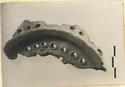
| Fragment preserving a little of ring foot, floor and lower wall; both floor and wall carefully pierced before firing.
Micaceous coarse clay unevenly fired; brownish-light red-grayish. Well in Stoa Shop ... March 1955 |
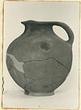
| Fragments of body missing; restored. Round-bodied oinochoe on ring foot; short neck, lightly trefoiled mouth; rolled handle, rim to shoulder. Blackened in a few places as if from burning.
Brown micaceous ... April 1955 |
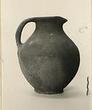
| Household oinochoe. Intact except for chips and small hole in lower wall. Slight trefoil mouth, rolled handle, ring foot. Globular body. Finger impression at lower handle attachment. fine slip, almost ... 13 July 1959 |
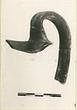
| Several joining fragments preserve back of lip and much of the rising double rolled handle.
Gray clay. Metallic black glaze, worn. Well beneath Stoa gutter, context ca. 520-490 B.C. 3780 Leica ... May-June 1954 |
| Mended from many fragments. Probably none of the lip preserved, but most of the ring foot (chipped), and the lower attachment of a double handle. Three small fragments possibly belong. Restored in plaster ... August-September 1932 |
|
|