|
|
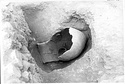
Refuse pit in rock by heavy wall on West Street ... Ca. 500-480 B.C ... Hole by Heavy Wall on West Street |
Byzantine Well at 66/ΛΑ.
Semi-curbed well at the west wall of the Byzantine room.
From the mouth of the well, a few brown glazed sherds ... Byzantine ... Semi-curbed well at the west wall of the Byzantine room.
|
Found while cleaning wall running east-west over 57. Contained late glazed pottery ... Byzantine ... Found while cleaning wall running east-west over 57. |
Amphora dump at P/2,3-6/6,8.
Layer "8b" in Room 6 of Greek House δ.
Trench cut into lower levels next to west wall of Room 6. Fragments of amphorai, tiles.
No coins ... Early Hellenistic ... Trench cut into lower levels next to west wall of Room 6. |
Pit in House N, Room 2 (RSY, House C). Filling thrown in behind the west wall of the Great Drain South at the time of the building of the drain and the extension of House C.
Cf. Hesperia 20 (1951), pp ... Ca. 430-410 B.C ... Filling thrown in behind the west wall of the Great Drain South at the time of the building of the drain and the extension of House C.
|
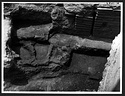
Located in road west of Middle Stoa. It was 4.80m deep. Owing to its shallowness, it was probably kept clean. The southernmost block of the N-S peribolos (?) wall west of the Middle Stoa partly covered ... 200-165 B.C ... Located in road west of Middle Stoa. ... The southernmost block of the N-S peribolos (?) wall west of the Middle Stoa partly covered the mouth of the well. |
| Pocket with burning at 60/ΚΗ. "Is this perhaps a disturbed pyre burial." [Nbp. 2928].
Identified as pyre by SIR.
Near north end of corridor, beside its west wall. Concentration of artifacts, tiny scraps ... 4th c. B.C ... Near north end of corridor, beside its west wall. Concentration of artifacts, tiny scraps of bone, and carbon in stratum, no pit discerned. the objects lay under an uneven strosis level with the bottom of the rebuilt west wall of the corridor, perhaps dug into a layer topped with marble chips. |
| Marcie Handler ... The Pyre was revealed in a layer of 4th c. fill in the north end of Room 6, just south of Wall 8. Room 6 is defined by the street wall (Wall A) on the west, Wall 7 on the east, Wall 9 on the south (preserved ... 4th c. B.C ... The Pyre was revealed in a layer of 4th c. fill in the north end of Room 6, just south of Wall 8. Room 6 is defined by the street wall (Wall A) on the west, Wall 7 on the east, Wall 9 on the south (preserved only as a stub on the east side of the area), and possibly Wall 8 or Wall 6 on the north.
2.5 meters SW of the pyre, a patch of floor surface at J/10-1/20 at 52.188 masl. was found. |
Hellenistic fill, north of Temple of Ares, on either side of wall running east-west over 50/ΙΓ. Mostly coarse pottery including many stamped amphora handles.
Cf. also nb. P XII, pp. 2297-2298. Coins:
13 ... 275-200 B.C ... Hellenistic fill, north of Temple of Ares, on either side of wall running east-west over 50/ΙΓ. |
Clearing bedrock on line of early (Archaic) peribolos wall, east of entrance on the south side, west end. Uncatalogued material: 50 sherds, 83 fragments. of plemochoai.
Classical Ware : lekythos; plemochoai ... Early 2nd c. B.C ... Clearing bedrock on line of early (Archaic) peribolos wall, east of entrance on the south side, west end. |
Mycenaean Tomb under Valerian wall (Burial 12).
It was impossible to fix the limits of the tomb in any direction, since at the north and south it was cut by the wall, an operations could not be extended ... Myc. III B ... Mycenaean Tomb under Valerian wall (Burial 12).
It was impossible to fix the limits of the tomb in any direction, since at the north and south it was cut by the wall, an operations could not be extended to the east and west, owing to the rapid flow of water from the surface of bedrock. |
Rectangular pit at 54/ΛΓ.
The pit's plan is irregular; its measurements approximately 2.00x1.10x1.15m. The wall foundations run a little over a meter deep at 53/ΛΓ-ΛΕ, consist of irregularly shaped and ... Ca. 450-425 B.C ... On top of these rest two good sized poros blocks which once supported the first blocks of the house wall. The south wall of the pit is built of slightly smaller stones and clay (no poros blocks), and bonds with the west wall. The east wall is one large (2.00x1.14x0.22m) poros slab. ... The north wall, of which only a few stones were left, would have been like the south wall.
|
House K: Brown fill (publ. House U). Filling between terrace wall and house wall at the extreme west end of the Areopagus; a brown gravelly filling of early Roman date found here undisturbed but occurring ... Early Roman ... Filling between terrace wall and house wall at the extreme west end of the Areopagus; a brown gravelly filling of early Roman date found here undisturbed but occurring also throughout this general vicinity, sometimes with later intrusions. |
| Marcie Handler ... Fill within the drain from the basin on the west side of Roman Room B through Wall A.
After we removed the fill within the basin on the west side of Roman Room B (BZ XXVII p. 5325), we began excavating ... Late Roman ... Fill within the drain from the basin on the west side of Roman Room B through Wall A.
After we removed the fill within the basin on the west side of Roman Room B (BZ XXVII p. 5325), we began excavating in the cutting on the east face of a conglomerate block that is part of Wall A. ... The cutting is probably a drain that carried water from the basin through Wall A and onto the North-South Road. |
Mycenaean Chamber Tomb W. of Circular Building (at Σ:30/ΛΕ?)
It had been badly disturbed by a fourth-century B.C. pit which cut into the northeast part of the chamber (rectangular, ca. 1.80m by 1.30m) ... Myc. III A 2 ... Only the one lying along the west edge of the chamber was well-preserved, with its head to the south, knees up, and with the pots at its feet. two more pots were found lying between this skeleton and the chamber wall. |
Located in front of west end of Stepped Retaining Wall, Heliaia. Filled in and covered in last stages of grading of area after construction of Middle Stoa.
Pottery from settling basin nondescript. Single ... 175-150 B.C ... Located in front of west end of Stepped Retaining Wall, Heliaia. |
| Hellenistic Pyre below packed clay floors of Room 2; west of Late Roman wall extension, below tile platform terracotta drain installation, bordered on the north by bedding foundation stones of crosswall ... Ca. 300 B.C ... Hellenistic Pyre below packed clay floors of Room 2; west of Late Roman wall extension, below tile platform terracotta drain installation, bordered on the north by bedding foundation stones of crosswall between rooms 2 and 3. |
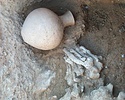
| Mycenaean grave to west of House N, room 5, with the burial of two young children. Rough rectangular cutting in soft stereo (0.95x0.64x0.28), lying under the western wall of a Geometric house, contained ... Myc. III C:1 ... Mycenaean grave to west of House N, room 5, with the burial of two young children. Rough rectangular cutting in soft stereo (0.95x0.64x0.28), lying under the western wall of a Geometric house, contained the doubled-up skeletons of two small children. |
| Pyre in House C, Room 12 (RSY=Pyre 9) in the industrial area west of the Areopagus.
Notebook refers to House N.
Beside west wall of room 12. Pottery, burnt bone, and cinders in a roughly round pit; disturbed ... Ca. 250 B.C ... Pyre in House C, Room 12 (RSY=Pyre 9) in the industrial area west of the Areopagus.
... Beside west wall of room 12. |
| Mycenaean Chamber Tomb under north side of Temple of Ares, towards its west end.(1951).
The tomb had a hasty and unfinished appearance oddly at variance with its long history and the quality of the pottery ... 1st: Myc IIB-IIA:1-2, 2nd: Myc. IIIC:1 (1450-1200 B.C.) ... The original dromos ran from west to east and entered the chamber toward the south end of the long west wall. ... A small niche, 0.50m square and raised 0.25m above the chamber floor, was set in the wall at the southwest corner of the room.
... Centered in the northeast wall, this second doorway was only 0.59m. wide, but well cut. |
| Mycenaean Tomb to NE of Pier 19 (Burial #1)
Most of the doorway and the dromos had been cut away by the ancient Stoa builders. The dimensions of the chamber were 2.90m wide by 1.60m deep. Unusual features ... Myc. III A:1 ... Unusual features of the tomb were a small recess in the back or south wall, in which stood the askos, and a rough stone slab which was found on the floor near the center of the east side, but which may once have been a grave marker at ground level.
... Two skeletons, both to the west of the entrance, extended with feet toward the door, seem to represent the latest interments, although the eastern one had been somewhat pushed to the side. In the southeast corner and along the west wall there were swept-up piles of bones and offerings from earlier burials, and in the northwest corner there was a small round pit (0.50m in diameter by 0.20m deep) full of bones. |
Well Y, in area North of the West end of the Yellow Poros Foundation. The shaft had cut through the wall of an earlier well and the cavity had been packed with stones by the diggers of the new well. In ... Earth 5th c. B.C ... Well Y, in area North of the West end of the Yellow Poros Foundation. The shaft had cut through the wall of an earlier well and the cavity had been packed with stones by the diggers of the new well. |
Wells at 24/ΙΓ at 26/ΙΑ near the SW corner of the market square, about 10m west of the Southwest Fountain House (the party wall between them broken through in antiquity).
Use filling middle to third quarter ... Ca. 550-525 B.C ... Wells at 24/ΙΓ at 26/ΙΑ near the SW corner of the market square, about 10m west of the Southwest Fountain House (the party wall between them broken through in antiquity).
|
Well of Christian Lamp; west of Stoa terrace wall near north end. Pottery spread out June 1952. A big amphora was made up (ΣΑ 1780), but nothing else went together. Fill appeared o be all of one period ... Late 5th-early 6th century A.D ... Well of Christian Lamp; west of Stoa terrace wall near north end. |
Child's burial in south wall of Marble Worker's House.
Bones examined 20 June 1975 and found to be an immature animal, not human (canid-puppy?).
Identified as pyre by SIR. Set into a shallow roughly ovoid ... Late 4th c ... Child's burial in south wall of Marble Worker's House.
... Set into a shallow roughly ovoid pit measuring ca. 0.27m east-west by 0.33m north-south. |
| Pyre in Horos Terrace Trench, East end, set into Strosis 5.
In room 1 (court), near north wall. Concentration in stratum, no pit discerned; described as a "little nest of pots" within layer V (Lot ΜΣ ... 350-325 B.C. |
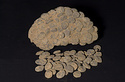
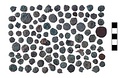
| Laura Gawlinski ... Coin hoard of Athenian tetradrachms. Dug into fill under floor (floor level not preserved) on east side of Strategeion near the NE corner of room formed by the eastern poros block wall and an east-west ... Second half of 4th c. B.C ... Dug into fill under floor (floor level not preserved) on east side of Strategeion near the NE corner of room formed by the eastern poros block wall and an east-west polygonal crosswall. The hoard describes an oval with its widest point running roughly east-west (0.211m), narrow dimension roughly north-south (0.140m) Forty-six found loose, the remainder fused together in cone-shaped mass, point at bottom, weight 6.280 kg (estimated 400 coins).
|
| RSY Grave 51.
The grave lay on the slope of the Areopagus in Roman house O, just east of the line where the hillside is scarped for the foundation of the west wall of the house.
Cutting:the pit cut in ... Archaic period/6th or 7th c ... The grave lay on the slope of the Areopagus in Roman house O, just east of the line where the hillside is scarped for the foundation of the west wall of the house.
Cutting:the pit cut in bedrock into which the burial was set measured 0.95m from north to south and 0.55m from east to west. Its depth was 0.65m. ... A foundation wall of the Roman house passed close to the mouth of the pithos, for which we found no cover; one may have been removed when the foundation was laid. |
| David Scahill ... At northeast corner of Classical Building II; on south side of dromos of Tomb K 2:5, and separated from it by ca. 0.6m of bedrock. Chamber cut through bedrock. The northeast corner of chamber defined ... LHIII A:1 ... Rest of tomb runs under later wall foundations to the south and west.
... Partially articulated skeleton laid out against the north wall of the tomb, with feet to the east. |
Laura Gawlinski ... Pebble floors of Roman date covered the northern half of a 6x6m square trench in ΕΛ, bounded to the west by the post-Herulian Wall and to the east by a wall from Byzantine Building D (Wall A) to the east ... Hellenistic/ 220-150 B.C ... Pebble floors of Roman date covered the northern half of a 6x6m square trench in ΕΛ, bounded to the west by the post-Herulian Wall and to the east by a wall from Byzantine Building D (Wall A) to the east. |
Fillings associated with Southwest and North Buildings (78-99/ΙΣΤ-ΚΘ) and early walls to west of Great Drain.
pottery p. 1189, vol VII ... Subdivisions:
.1=Filling over bedrock.
.2=Fillings behind retaining ... Various levels and dates ... Fillings associated with Southwest and North Buildings (78-99/ΙΣΤ-ΚΘ) and early walls to west of Great Drain.
... Subdivisions:
.1=Filling over bedrock.
.2=Fillings behind retaining wall and in road.
.3=Dumped fillings probably of construction of Great Drain.
.4=Fillings of reuse of walls in north part of area.
.5=Late fillings over early walls. |
Wells at 24/ΙΓ at 26/ΙΑ near the SW corner of the market square, about 10m west of the Southwest Fountain House (the party wall between them broken through in antiquity). ... Ca. 500 B.C ... Wells at 24/ΙΓ at 26/ΙΑ near the SW corner of the market square, about 10m west of the Southwest Fountain House (the party wall between them broken through in antiquity). |
| Bronze-casting pit and furnace against S apse of Church (106/ΛΕ). Late Roman sherds of the 4th and the 6th c. A.D. were found with fragments of moulds from bronze casting. The west end was destroyed by ... 5th-6th c. A.D ... A.D. were found with fragments of moulds from bronze casting. The west end was destroyed by the church builders. There is a tile floor set on bedrock and two brick piers of the south wall stand to a height of 1.12 m.; one scrap of the north wall establishes a width of 1.05m. |
| Disturbed Pyre at 59/ΚΗ (ΚΖ), in the area of the Poros Building west of the Areopagus.
Against east wall of room 5 west. concentration of artifacts, ash, carbon and a few bones in stratum, no pit discerned ... 3rd c. B.C ... Disturbed Pyre at 59/ΚΗ (ΚΖ), in the area of the Poros Building west of the Areopagus.
Against east wall of room 5 west. concentration of artifacts, ash, carbon and a few bones in stratum, no pit discerned. |
| David Scahill ... Below packed clay floors in Room 2 of Classical Building II; bordered on east and south sides by polygonal cross wall and back wall extension for Classical Building. Late Roman wall and drain installation ... LHIII A:1 ... Below packed clay floors in Room 2 of Classical Building II; bordered on east and south sides by polygonal cross wall and back wall extension for Classical Building. Late Roman wall and drain installation above west side. ... Toward the west against the north side, a bronze dagger and spear point. |
Michael Laughy ... West and adjacent to Modern Wall 5, we excavated 12th-13th c. A.D. fill, in some places a half meter deep or more. The fill was remarkably uniform in content throughout. Typical pottery included: fine ... 12th-13th c. A.D ... West and adjacent to Modern Wall 5, we excavated 12th-13th c. |
Built against the south wall of the annex to the Poros Building
west of the Areopagus. At the west the upper layer of marble chips carried against it, the lowest were cut by it.
Part of same system as ... 225-100 B.C ... Built against the south wall of the annex to the Poros Building
west of the Areopagus. At the west the upper layer of marble chips carried against it, the lowest were cut by it.
|
| Sacrificial pyre in Poros Building, NW Room (RSY= Pyre 1).
Against east wall of room 5 west. artifacts, bone, carbon and ash in pit in floor sequence. the pyre lay below a floor covered with marble dust, ... Middle of 4th c. B.C ... Against east wall of room 5 west. artifacts, bone, carbon and ash in pit in floor sequence. the pyre lay below a floor covered with marble dust, the lowest floor that can be associated with the north wall of the room. |
| Marcie Handler ... Continued from 2000 season, 10-12 July 2000; BZ XXIII p. 4472.
The hoard was originally excavated during the 2000 season (Lot BZ 1049, 5th-6th centuries AD), from a higher elevation through a gap in the ... 10-12 July 2000
21-22 July 2003 ... The hoard was originally excavated during the 2000 season (Lot BZ 1049, 5th-6th centuries AD), from a higher elevation through a gap in the stones of Wall A, and was thought to be the bottom of a foundation trench for the wall. ... Foundation trench of N/S street wall, in ash pit. 53.505m-53.089m. -Basin on the west side of Room F. 53.084-53.275m. (2003)
17 coins: ΒΖ-1418 - ΒΖ-1434 |
| Handler ... Found in an area of disturbed fill north of a floor surface in Room 4 of the Classical Commercial Building. The floor surface (n. 3 on the west side of Room 4) was preserved at 52.503-52.544 masl., and ... 2nd half 4th c. B.C ... The floor surface (n. 3 on the west side of Room 4) was preserved at 52.503-52.544 masl., and was excavated in Lot ΒΖ 1758 (2nd half of the 4th c. ... The pyre was located in a shallow channel adjacent to the south face of Wall 4, where the floor surface was not preserved. |
|
|