|
|
Deposit at 42/ΙΕ beside rubble wall under modern cellar wall ... 5th c. B.C ... Deposit beside Rubble Wall |
Pocket behind heavy Roman retaining wall ... 4th c. B.C ... Pocket behind heavy Roman retaining wall. |
Above well at 48/ΙΕ (J 15:1) ... Early Roman ... Pit with Wall |
Pocket in bedrock behind stepped retaining wall ... 7th c. B.C ... Pocket in bedrock behind stepped retaining wall. |
Dug as Tholos Trench V, Room E, burnt filling of plundered wall trench of S wall of court. See also lot Ζ 484 ... Late 6th c. B.C ... Dug as Tholos Trench V, Room E, burnt filling of plundered wall trench of S wall of court. |
Refuse pit in rock by heavy wall on West Street ... Ca. 500-480 B.C ... Hole by Heavy Wall on West Street |
Found during removal of late Roman wall in area Ι/11. No container ... 28 June 1967 ... Lamp Deposit beside Roman Wall |
Coin Hoard found at LRF wall as it runs over the paved court of the Klepsydra, North Slope ... 6-16 June 1937 ... Coin Hoard found at LRF wall as it runs over the paved court of the Klepsydra, North Slope. |
Rectangular cutting at 58-60/ΚΘ-Λ, probably a plundered wall trench ... 350-290 B.C ... Rectangular cutting at 58-60/ΚΘ-Λ, probably a plundered wall trench. |
Hephaisteion Garden; fill beside wall. Loose filling encountered in rescue excavation to examine wall found during construction of public toilet in Theseion Park, outside Agora area. SIR 1991
Originally ... Second half of 4th c. B.C ... Hephaisteion Garden; fill beside wall. Loose filling encountered in rescue excavation to examine wall found during construction of public toilet in Theseion Park, outside Agora area. |
| Marcie Handler ... The Pyre was revealed in a layer of 4th c. fill in the north end of Room 6, just south of Wall 8. Room 6 is defined by the street wall (Wall A) on the west, Wall 7 on the east, Wall 9 on the south (preserved ... 4th c. B.C ... The Pyre was revealed in a layer of 4th c. fill in the north end of Room 6, just south of Wall 8. Room 6 is defined by the street wall (Wall A) on the west, Wall 7 on the east, Wall 9 on the south (preserved only as a stub on the east side of the area), and possibly Wall 8 or Wall 6 on the north.
2.5 meters SW of the pyre, a patch of floor surface at J/10-1/20 at 52.188 masl. was found. |
Found while cleaning wall running east-west over 57. Contained late glazed pottery ... Byzantine ... Found while cleaning wall running east-west over 57. |
Small pocket between the tumbled wall of large conglomerate blocks and Drain 2 ... 4th c. B.C ... Small pocket between the tumbled wall of large conglomerate blocks and Drain 2. |
| Kernos Pit #1 under Valerian Wall. P 30173-P 30174 added on May 7, 1973 ... 4th c. B.C ... Kernos Pit 1 under Valerian Wall |
Filling around rubble wall (35/ΚΕ). It contained a mass of pottery, most of it uninventoried ... Ca. 425-400 B.C ... Filling around rubble wall (35/ΚΕ). It contained a mass of pottery, most of it uninventoried. |
Filling in the footing trench of the late Roman Fortification.
Includes Layer 1 and Layer 2 of Library Colonnade opposite Room 2. "Note: both these layers are fill thrown into V.W. footing trench." (nb.p ... End 3rd. c. A.D ... Footing Trench of Venetian/Valerian Wall |
Filling behind retaining wall of Stoa of Zeus. The remains of unfired clay adhering to the interior of various pieces make it probable that the material in this filling is a mass of debris from the floor ... Ca. 435-425 B.C ... Trial Pit behind Stoa Retaining Wall |
Stoa of Attalos (Shop VI), between poros orthostates of front wall. No deposit list ... Stoa of Attalos (Shop VI), between poros orthostates of front wall. |
Late Roman Building to W of N end of Stoa (from its wall and below floor) Coins:
July 12 1950 #1-#4 ... 11-12 July 1950 ... Late Roman Building to W of N end of Stoa (from its wall and below floor) |
Mycenaean Tomb under Valerian wall (Burial 12).
It was impossible to fix the limits of the tomb in any direction, since at the north and south it was cut by the wall, an operations could not be extended ... Myc. III B ... Chamber Tomb under Valerian Wall, Burial 12 |
Well at 56/ΚΖ, just south of the south wall of the northern Late Roman Building ... Second half of 2nd c. - early 3rd c. A.D ... Well at 56/ΚΖ, just south of the south wall of the northern Late Roman Building |
Classical Pit under Rubble Wall of Predecessor of Square Building and above Geometric Well (Q 8:9) ... Classical Pit under Rubble Wall of Predecessor of Square Building and above Geometric Well (Q 8:9) |
Well at 40/Λ, in the "plataia" ca. 600m north of the terrace wall and ca. 10m east of the Valerian wall. Top diameter of 1.00m, bottomm diameter 0.95m
The shallowness of the shaft, and the fallen condition ... 550-500 B.C ... Well at 40/Λ, in the "plataia" ca. 600m north of the terrace wall and ca. 10m east of the Valerian wall. Top diameter of 1.00m, bottomm diameter 0.95m
The shallowness of the shaft, and the fallen condition of the rock wall suggested that the well was abandoned and filled immediately, before completion. |
Clearing bedrock on line of early (Archaic) peribolos wall, east of entrance on the south side, west end. Uncatalogued material: 50 sherds, 83 fragments. of plemochoai.
Classical Ware : lekythos; plemochoai ... Early 2nd c. B.C ... Bedrock on Line of Early (Archaic) Peribolos Wall |
Destruction debris in L.R. water basin, 6th-7th c. A.D, set against back wall of South Stoa II ... 6th c. or 7th c. A.D ... A.D, set against back wall of South Stoa II. |
Pit along house wall foundations to south = footing trench. Uncertain context, possibly no later than ca. 425 B.C ... 450-400 B.C ... Pit along house wall foundations to south = footing trench. |
Valerian Wall, undisturbed contents: Lower stretch.
Not on concordance, not on cardex neither. No info. Asterisk: R 15-16* ... Valerian Wall, undisturbed contents: Lower stretch.
|
Valerian Wall, undisturbed contents: Upper stretch.
Not on concordance, not on cardex neither. Asterisk: S 16-17* (no info) ... Valerian Wall, undisturbed contents: Upper stretch.
|
| Marcie Handler ... It was situated in the NW corner of Room 3 in the Classical Commercial Building, just S of Wall 11, the cross-wall that divides Room 3 from Room 4 to the north. The pyre pots were found surrounded by ... Late 4th c. B.C ... It was situated in the NW corner of Room 3 in the Classical Commercial Building, just S of Wall 11, the cross-wall that divides Room 3 from Room 4 to the north. ... The pyre deposit continued up to the north face of late Roman Wall C, suggesting that these lower courses of Wall C were packed into a narrow trench instead of built up within a wider foundation trench. |
| Pyre against north face of polygonal wall, Room 2, Classical Building II. No floor preserved above, but the pyre is below floor level 51.820masl, preserved just to the east and above patchy floor with ... Ca. 275-260 B.C ... Pyre against North Face of Polygonal Wall, Room 2 |
Material from trenches:
a) 1.00-7.00m. from East End of Stoa.
b) 18.40-21.40m. from East End of Stoa.
c) 46.60-48-60m. from East End of Stoa.
d) 51.00-53.00m. from East End of Stoa.
e) 79.00-81.00m. from ... 2nd c. B.C ... Drain and drain channels/trenches at Stoa back wall |
Fill against back wall foundations of Royal Stoa I/6,9-4/8,14. Dug separately, these many fills contain material which joined horizontally and vertically all along back wall of Royal Stoa. Fill seems to ... 2nd/3rd quarters of 5th c.-420s ... Fill against back wall foundations of Royal Stoa I/6,9-4/8,14. Dug separately, these many fills contain material which joined horizontally and vertically all along back wall of Royal Stoa. |
The deposit notebook lists S 1439 here, but the following information on that card indicates that D 18:4 could be considered with D 18:3 and not as a separate deposit.
"Excavation of pit, which partly ... Casting pit on line of Poros Building S. wall. |
Small pit north of Wall C (appr. 0.50 E-W x 0.35m N-S). Coins:
11 August 1994 #1125-#1127 ... 3rd c. B.C ... Small pit north of Wall C (appr. 0.50 E-W x 0.35m N-S). |
Filling over and behind blocks of E. wall of Great Drain at 10-15/Α-Γ. Coins:
10 May 1954 #1-#2 ... 3rd c. B.C ... Filling over and behind blocks of E. wall of Great Drain at 10-15/Α-Γ. |
| Marcie Handler ... The contents of this Hellenistic cistern shaft were excavated in a series of layers: the preserved top of the shaft, six layers in the shaft and the fill within the tunnel. At the bottom of the shaft on ... POU: Mid-3rd c. BC
Dumped fill: after 225 BC ... Excavations | 2007 | Trenches | Handler | Room M | East of Wall 7 | Cistern J 1:7 |
Fillings behind retaining wall and in road.
SW Building, rooms 3, north, south. Coins:
13 March 1934 #1, #2
14 March 1934 #37
15 March 1934 #37-#38
24 March 1934 #31 ... 6th c. B.C. and earlier ... Fillings behind retaining wall and in road.
SW Building, rooms 3, north, south. |
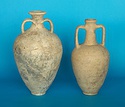
| Marcie Handler ... A deposit of six amphorae and one micaceous water jar was excavated between 20 June and 6 July 2005 in the area north of Wall K. The neck and one handle of one of the amphorae (BZ 1213) had been poking ... Ca. 1st c. A.D ... A deposit of six amphorae and one micaceous water jar was excavated between 20 June and 6 July 2005 in the area north of Wall K. The neck and one handle of one of the amphorae (BZ 1213) had been poking out of the surrounding fill since the end of the 2001 season. |
Pocket in bedrock, 50/Λ (= Trench, 50-54/Λ), measuring 4.00x0.60m, 0.60-0.90m deep; possibly cutting for wall foundation Coins:
22 April 1932 #1 ... 330-300 B.C ... Pocket in bedrock, 50/Λ (= Trench, 50-54/Λ), measuring 4.00x0.60m, 0.60-0.90m deep; possibly cutting for wall foundation |
| Burned Deposit. A thick deposit of ash, cinders and pottery fragments extending alongside wall of cemetery. Character of pottery like the pyre of F 12:2 ... Late Geometric ... A thick deposit of ash, cinders and pottery fragments extending alongside wall of cemetery. Character of pottery like the pyre of F 12:2. |
|
|